
StraightSmile Solutions®
Close Missing Molar Spaces with Invisalign or Braces

Have you ever wondered about the benefits and limitations of Invisalign and braces? In many cases, these are among the most reliable, professional, and practical ways to tackle orthodontics cases – but even with the best possible approach, they can’t fix the impossible. With this thought in mind, today, we’re looking at whether it’s possible to close a patient’s missing molar spaces with Invisalign or braces – and what this might mean.
Can I Close Missing Molar Spaces with Invisalign or Braces?
In some cases, it may be possible to close missing molar spaces with Invisalign or braces. However, this comes with several limitations, and attempting to do this may cause damage to another aspect of the patient’s jaw structure if you’re not careful.
If the patient already has a good bite, you’ll likely want to avoid closing missing molar spaces with braces or Invisalign. However, if there is more room for movement – e.g., if the patient already has an overbite and there’s room for a change on the other side of the mouth – this could be a viable option.
In the end, this all comes down to a case-by-case basis. Don’t just use a set approach; make sure you’ve considered the patient’s key features to choose the ideal approach.
Find Out More About Closing Missing Molar Spaces
If you need further support regarding Invisalign and braces for missing molar spaces, don’t hesitate to contact our experts here at Straight Smile Solutions today. As your leading Invisalign and braces consultants, we can help you discover the right strategy for a particular case.
How to Start with Virtual Care Invisalign

When it comes to your Invisalign consulting services, knowing where to start can often seem challenging – but this shouldn’t have to be the case. With this thought in mind, we’re looking at some of the critical things you should know about the upcoming virtual Invisalign dentist consultation service.
What is the New Invisalign Virtual Care 3.0 AI Consulting Solution?
If you’ve been looking for ways to modernize your Invisalign dentist consulting, have you ever thought about trying out the new Virtual Care 3.0 solution? This unique plan is designed with dental care providers in mind, allowing you to deliver optimal services for your clients.
Unnecessary visits can be a major limitation for many people. However, these can be largely eliminated by using virtual care to enhance your regular dentist consultation visits. With the new Invisalign AI consulting solution, this is easier than ever. This unique system allows orthodontists to monitor patients’ progress more accurately than ever, making it a vital tool for almost any provider.
Find Out More About Dentist Consultation Solutions Today
If you’d like to get started with offering dentist consultation services, there’s a lot you’ll need to keep in mind. Fortunately, if you have been struggling with this decision, our Straight Smile Solutions experts can help. So, contact us if you need any further ideas regarding our consulting solutions.
Who wants to work with us in 2027?
 Have you been looking for a new business venture or opportunity? As a professional orthodontics provider, we here at Straight Smile Solutions are always looking for new opportunities to grow the opportunities for both our partners and us. And so, coming in 2027, we’re launching a new opportunity that will help take everyone’s careers to new heights.
Opportunities for Strategic Partners
If you have been looking to open your own orthopedics office, why not partner with our team at Straight Smile Solutions to run the ortho for you? Especially for businesses in California, this unique solution will help offer new ventures for many people across the region.
The selling point is simple: it’s only removables, helping provide greater appeal for orthodontics cases. In other words, the focus will be on appliances over braces, giving greater solutions that align with your patients’ demands and expectations more easily.
It’s more than just a generic solution; the core focus will largely be on virtual consulting solutions. This helps make the plans easier for patients and the clinic overall.
Find Out More
If you’d like to find out more about the value of our new Straight Smile Solutions orthodontics services for California-based orthopedics clinics, contact our team today. We’re here to help you find the ideal plan for your own business ventures, helping take your business model to the top.
Help Setting up Invisalign Personalized Plan
 Help Setting up Invisalign Clinical Preferences and Personalized Plan
If you are looking for help with Invisalign® personalized plan or clinical preferences, this is included in every Concierge and VIP membership but if you are ONLY looking for help setting up your plan/preferences and NOT with any case support, you can schedule this independently. The cost is $900 for up to one 50 minute meeting to help you navigate preferences and a personalized plan.
The benefits of this is simplifying the submission process to fit your treatment objectives for all kinds of malocclusions in BOTH adult and teens: crowding, Class 2, Class 3, Openbite and Deepbite Cases. We recommend that you watch the videos in our Invisalign® playlist FIRST before signing-up.
Steps:
1. email us to get started- [email protected]
2. We’ll send you a TOS to sign through Docusign and a Stripe link to check out
3. Once that is returned, we’ll send you a link to schedule your session via Zoom at your convenience- please make sure you have the prompt from your Invisalign® TM to access this survey for submission
Attachment Breakage in Clear Aligners and Invisalign

Avoiding Attachment Breakage for Invisalign and Ortho Clear Aligners
Have you ever faced difficulties with attachment breakage for Invisalign and ortho clear aligners? In many cases, breakage can be a major source of frustration, leaving you having to do a lot of revisions and refinements.
Naturally, this can be a major source of frustration for patients and can be incredibly disruptive; as such, making sure you’ve avoided attachment breakage for Invisalign and ortho clear aligners is critical.
How to Avoid Attachment Breakage for Invisalign and Ortho Clear Aligners
Attachment breakage can significantly compromise the success of your Invisalign and ortho clear aligners cases. However, there are ways that you can reduce the chances of breakages.
Generally speaking, any problems that occur within the first 24 hours are likely to be the fault of the orthodontist. However, later issues may be harder to identify in terms of causes.
In order to avoid attachment breakage, one of the first things you’ll want to do is call the patient within this 24-hour period to make sure that everything’s going to plan. Counting the attachments at delivery can allow you to make sure that the attachments are all there and unbroken before aligner changes.
It’s worth noting that certain foodstuffs could also cause the attachments to get damaged – for example, candy bars or nuts. Crunchy foods are generally a risk for attachment breakage.
If you’re unsure, make sure you check the patient’s ClinCheck. It’s also worth noting that attachments can’t break while the ortho clear aligners are in, so if you’re having difficulty, you may want to advise that the patient avoids taking them out.
Final Thoughts
No doubt, ortho clear aligners and Invisalign cases can become incredibly disrupted when the attachment breaks. However, there are several reasons why this might happen. And, while you can’t always prevent it, you can take steps to make sure it’s not likely to be your fault when it does happen.
Social Media for Dentists

NEW to the Straight Smile Solutions services list is our exclusive social media content-only package. We’ve always offered social media support for our VIP dentists, but we’ve heard the call for a content-only option.
This service will be offered a la carte, with content to help boost the social media presence of orthodontists and dentists.
What You Get:
– Social media resources
– Social media assistance
– Content created by our team
– Two strategy calls
Requirements
1. Existing, active social media accounts – minimum of 500 followers.
● You should be posting regularly and interacting online.
● We will with Twitter, Lemon8, Facebook, Instagram, YouTube, and LinkedIn.
2. You must purchase or provide any images involved in your posts.
● You can use stock photos or a photo of a patient, your team, or what’s going on in your office.
● You will need to have social media releases or have purchased stock photos.
Pricing
One-Time Full Package – $2,000
Includes two strategy calls, deliverables, and editing time
Strategy Calls
The initial strategy call is to discuss what you want to emulate online.
The second strategy is to see if you like what we’ve made, need anything modified, and discuss how to promote engagement on your content.
Both calls are included and are a max of 20 minutes.
Deliverables
From the media you provide, we will supply you with:
● 10 finished static image posts
● 5 short video posts
● or a combination of the two
Why Social Media for Dentists?
Social media agencies tend to post incorrect information about dentistry. We started helping dentists and orthodontists with social media content so you can have dentistry content to post that is correct and you are confident in.
FAQs
Available on www.straightsmilesolutions.com!
Invisalign Personalized Plan- 2023 Innovation Day Update

Invisalign personalized plans. This new feature is designed to simplify the submission process for Invisalign cases. It’s exciting news for anyone who works in the dental industry and uses Invisalign regularly.
Invisalign personalized plans are an innovative update to the Invisalign treatment process announced at the 2023 Innovation Day. This feature aims to streamline the procedure for submitting Invisalign cases, facilitating the development of customized treatment plans by dentists and orthodontists for their patients.
The Invisalign personalized plan feature uses a digital platform to help dentists and orthodontists create treatment plans for their patients in just a few easy steps. The process begins by digitally scanning the patient’s teeth and uploading them to the Invisalign software. The software then uses advanced algorithms to create a personalized treatment plan for the patient, considering their unique dental needs and goals.
This feature also allows dentists and orthodontists to review and modify the treatment plan as needed, ensuring that the patient’s needs are met and that the treatment plan is effective. Once the treatment plan is finalized, it can be easily submitted to Invisalign for manufacturing, streamlining the process and reducing the risk of errors or delays.
The Align Technology Innovation Day 2023, three major things Align Technology announced:
1. The first announcement was about Invisalign Personalized Plans, making things much easier for certain cases. This new feature eliminates repetitive questions; the 10-page submission will be condensed to just one page.
2. The second announcement was about Invisalign’s First Teen with Mandibular Advancement.
3. The third announcement about Invisalign Go for Phase 2 cases.
The Invisalign Personalized Plan is an innovative and exciting development in the field of orthodontics. The 2023 Innovation Day update has demonstrated this technology’s incredible potential to transform how we approach teeth straightening. By leveraging advanced AI algorithms and machine learning, the Invisalign Personalized Plan can provide patients with highly personalized treatment plans tailored to their unique needs and preferences. This results in more effective and efficient treatment and a more comfortable and convenient experience for patients. As we continue to see advancements in this technology, we can expect even greater improvements in orthodontics, making it easier and more accessible for people to achieve the smile they’ve always wanted.
8 Ideas to Optimize Your Invisalign Cases

Invisalign Clinical Preferences You Could Try
Have you been looking for the best way to optimize your own work with Invisalign? If this is something you have been considering, there’s a lot you may want to think about – and we’ve summarized some of our own favorite Invisalign consulting tips to help you take control over your own cases. But, of course, it’s worth considering that not every option will necessarily match every case, so be sure to tailor this to your patient’s unique needs.
8 Ideas to Optimize Your Invisalign Cases
#1 Make Cases Twice as Long
One of the first options you may want to look at is whether the patient could benefit from their Invisalign case being longer. A longer Invisalign case may result in better results – although it is naturally a lot more expensive for the patient.
#2 Add Anterior Bite Turbos
Another option is adding bite turbos to your cases (and remove bite turbos 3 aligners before finishing cases). These are highly applicable for almost every case unless there is an issue with the crown-to-root ratio or the like.
#3 Finish Cases with 3 Points of Molar Acclusion and 2 Points of Premolar Occlusion
Where possible, you may want to consider finishing cases with three points of molar acclusion and two points of premolar occlusion. Of course, this may not necessarily apply in cases where you have retained baby teeth or implants.
#4 Use Attachments Over Power Ridges
It’s not uncommon to use power ridges, but attachments may better fit your patient’s needs. As such, if this might be something that’s worthwhile for your patients, make sure to consider if this could offer benefits.
#5 Fully De-Rotate Premolars
In some cases, premolars may not necessarily straighten up readily. In line with this, try to check this when doing Invisalign to ensure you have fully de-rotated premolars if necessary. Premolars may not always be automatically straightened, so sthis is important to keep in mind.
#6 Add Mesial Root Tips to Upper 2s
In many cases, return cases – especially if you’ve been using CBC functionality – will see distal tips that haven’t been uprighted. As such, you may want to add mesial root tips to upper 2s; slanted teeth with unparallel roots can cause poor loading of the teeth.
#7 Properly Torque 2-2
Always make sure you properly torque 2-2, based on the level needed by your patient. This may be something you need to ask for as part of your Invisalign orthodontics cases; luckily, Invisalign should be able to cater for this if you ask for greater tension on the 2-2.
#8 Level Inscisal Edges
Another option you could consider is leveling the inscisal edges. Not all patients will need it, but any slight issues may leave you needing to consider this to prevent further issues down the line.
#9 Upright Molars
As a final tip, don’t forget to ask Invisalign to upright molars if you want to help with results when finishing cases. These processes often take a lot of time, so make sure that you’ve asked for this at the outset.
Final Thoughts
If you’ve been looking for ways to optimize your Invisalign cases with clients, we strongly recommend trying some of today’s tips. While they may not suit or be necessary for all patients, considering whether they could help might make a big difference.
If you have any further questions about the optimal way to streamline your own Invisalign cases, don’t hesitate to contact our experts here at Straight Smile Solutions for your own consulting session. We can help with one-off cases or longer term solutions to ensure you’ve got the optimal plans in place.
Keywords
Invisalign
Invisalign consulting
Orthodontics
Straight Smile Solutions
Finishing cases
How to Remove Composite Adhesive Bracket Cement

Removing Composite Adhesive Bracket Cement
Have you ever wondered how you should remove composite adhesive bracket cement from braces? In many cases, there can be several ways to go about this, but making sure you’ve chosen the right approach is crucial. After all, composite adhesive bracket cement isn’t overly nice for the patient, so you’ll want to make sure you’re finishing cases thoroughly and accurately by removing the adhesive.
How to Remove Composite Adhesive Bracket Cement
So, you’ve removed a patient’s braces. This is always a hugely exciting time both for the patient and their orthodontics provider – however, you’ll want to make sure you’ve removed all of the composite adhesive bracket cement before letting them head home after finishing cases.
In order to do so, you will need a specialist instrument to help remove the adhesive. These are different from band removers, which are usually curved; instead, these tools will be sharper and excellent for removing the adhesive that previously held the braces in place. They can often remove around 95% of the total composite material.
It’s worth noting that there are such things as non-disposable tools, too. These feature a removable blade and may offer good value for money, depending on your requirements.
Final Thoughts
Don’t leave your patients with only half-finished cases! Generally speaking, most states allow staff to remove super gingival adhesive bracket cement on your behalf. So, this may not even need to take up much of your time. What’s not to love?
Why any History of Facial Trauma should be a red flag on an Ortho or Invisalign Case
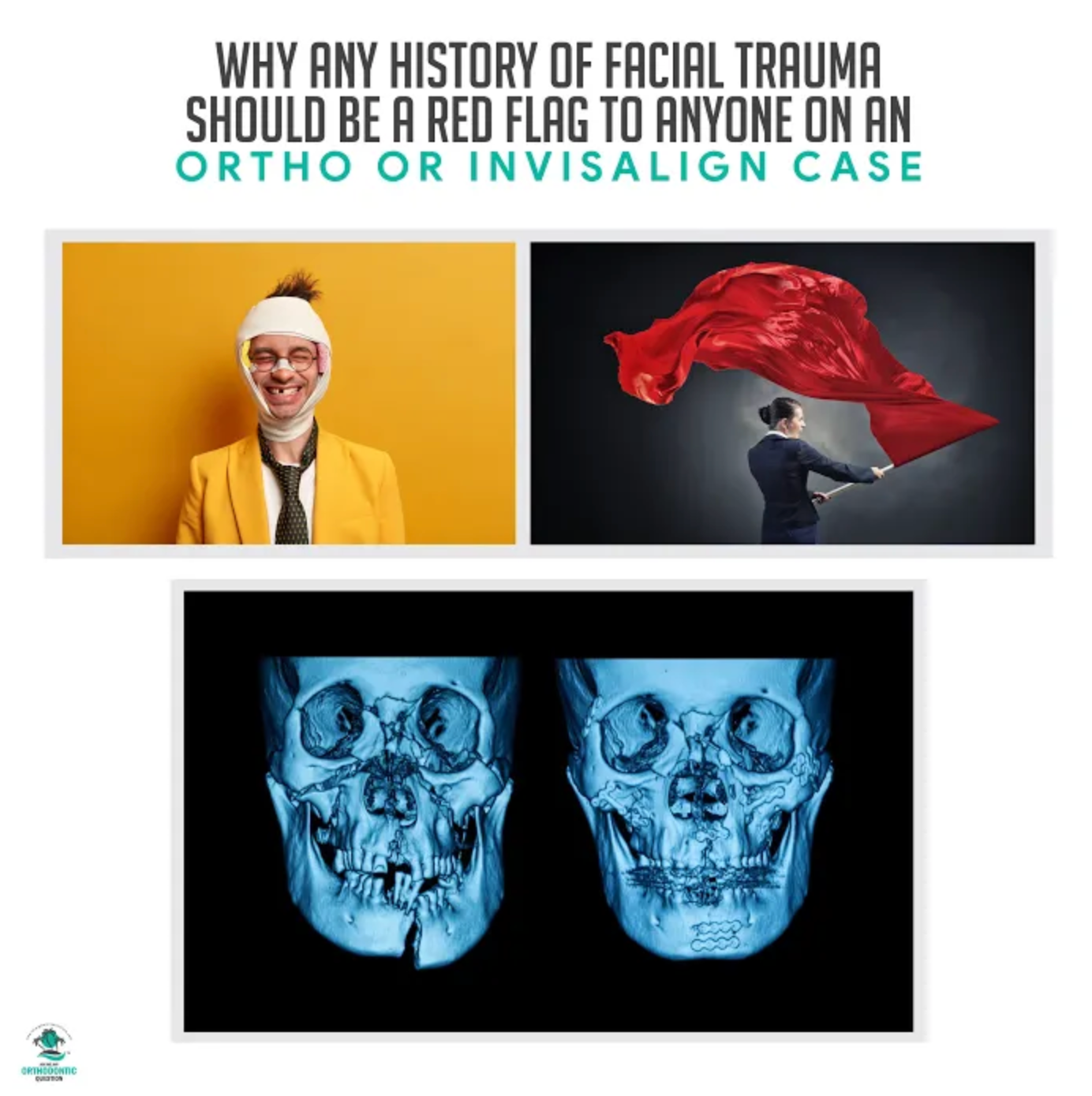
Why any History of Facial Trauma should be a red flag on an Ortho or Invisalign Case
Today, we’ll look at some of the reasons why any orthodontist should be cautious with cases that have a history of oral face trauma, automotive trauma, or trauma from a bike or skateboard accident.
As an orthodontist, I keep an eye out for unusual bites or patients who discuss things like how they had braces on before getting into a car accident. Some patients report that they were in a skating or skiing accident and their bite was never the same again. Patients who report such cases should be treated with caution.
I wish to promote awareness among general dentists, pediatric dentists, and dental specialists. When a patient arrives, the standard procedure is used to examine for the PDL, laminadura, and root absorption. Any injured teeth are more likely to experience root resorption, root blending, and pupal necrosis after orthodontic therapy. It’s in every single one of them. If I noticed anything unusual in the x-ray, I would refer them to an endo before proceeding with the case. They do this occasionally, but not always.
Whatever decision endo makes is what you as an orthodontist should go with. Sometimes endo can clear it or they can tell you to follow up with frequent x-rays. Even if you didn’t notice anything funny in the x-ray or even if I didn’t send the teeth to endo, I would still flag those teeth. I would put up a popup every few months to remind me to be cautious with such a case.
You should also let the patient know that you will be monitoring their teeth every once in a while. Let the patient know that frequent x-rays will be part of the standard treatment plan if they want to proceed.
Let’s talk about bones. If an orthodontists notices that a panel has a bunch of pleats and screws, that’s a dead giveaway. The orthodontist should probably not take that patient. Such a case might require the services of a jaw surgeon. I don’t recommend that any GP take a former trauma case or a former jaw surgery case. So many things can happen and once the orthodontist starts it, they will have to finish it and they will have to manage everything that comes up. If you notice pleats and screws, it’s a no go.
Even if you don’t see plates and screws but you have heard a history of trauma and you see a funny bite or the patient mentions a bite has which has shifted, get a CBCT scan of the jaws by a company like beam readers. There are plenty of other radiology companies that do great work as well and are affordable and if you are one, I get no compensation from referring to them. If you are a good Radiology company, I would like to talk to you.
A company like beam readers would take the CBCT and charge you for the reading. You should know how you can build this extra cost into your pricing. If you go ahead and take CBCT, there is going to be an extra cost. If there is any scar tissue or a minro fracture that the patient didn’t know about. Sometimes, you get into trauma and there is a minor fracture and it doesn’t need to be set, you don’t need plates and screws as it will just heal itself. In the process of healing itself, it creates a bump or lineage or demarcation and the joint where it heals is not seamsless. Teeth don’t move predictably in that area.
Teeth don’t move well in an area of scar tissue so I would want the beam readers or a similar company to read that CBCT of the maxilla and the mandible together and look for any issues in the bone of pathology that might affect the movement of teeth.
CBCT scans are costly, but they are worthwhile. If you start moving teeth in an area where there has been trauma, it will absorb that tooth and you will be accountable. You’d be upset if I rushed into your situation as a patient. At the very least, counsel the patient. Even if there was a trauma area, you could always choose not to move that tooth. You may advise, “Don’t move tooth number 19, just lock it,” especially if you’re using invisalign or clear liner. You can still achieve a good result without moving the teeth.