
StraightSmile Solutions®
Cephs
CEPHs
If you have been trying to take or interpret CEPHs, knowing where and how to start is highly important – and this is something that can often seem challenging for new general dentists and orthodontists. However, a CEPH x-ray is often pivotal for the successful treatment of a challenge in patients, which is why our collection of videos focuses on CEPHs to bolster your learning.
What is a CEPH?
A CEPH is a vital part of the Invisalign before and after process for many orthodontists, providing a thorough view of the patient’s jaw. This simple process allows an orthodontist to analyze facial bone and soft tissue, making suitable treatment plans easier with minimal revisions, refinements, or delays.
However, while the CEPH x-ray can be a little tricky to interpret, this becomes relatively easy once you know what you’re looking for. As such, our CEPH playlist covers all of the basics you’ll need to know before starting an Invisalign course, from tracing a CEPH to filling out referrals and more.
Optimize your Results with Our Easy Orthodontics Courses and Videos
No matter how long you’ve been working in the orthodontics field, there’s always room to learn more – and our free online orthodontic courses and videos can help. Indeed, here at Straight Smile Solutions, we’ve made it our mission to create easy orthodontics guides to support our consulting services, and we firmly believe that many orthos could use these guides to further their own treatment plans.
So, whether you’re new to orthodontics or if you’re just dabbling in CEPHs more thoroughly for the first time, we’re here to help. Discover our CEPHs easy orthodontics playlist here to increase your knowledge and accurately assess patient cases.
Keywords
Easy orthodontics
Orthodontic courses
Invisalign
Revisions
Invisalign before and after
Impacted Canines
Impacted Canines Introduction
If you’ve ever encountered an impacted canine case, knowing how to develop an effective treatment plan can sometimes be tricky. However, before ortho starts to become difficult, looking at some of the common challenges is crucial – and our ortho training videos could offer the ideal place to start. Indeed, we recognize the challenges that can come with impacted canines, and so we’ve outlined the main things you need to know before ortho case starts.
The Challenge with Impacted Canines
Impacted canines can be challenging cases. Indeed, every patient is unique, so ortho training comes with several key difficulties to remember.
Fortunately, if an impacted canine case has left you feeling a little stuck, our impacted canines videos cover all manner of different topics. These range from using Invisalign to help form a treatment plan to checking the patient’s progress with ClinCheck, ensuring you’ve got the knowledge you need to help the patient’s ortho course progress smoothly.
Learn More About Impacted Canines Treatment Planning
Though impacted canines can be a tricky case to face, there are plenty of ways to tackle this. Accordingly, knowing how to handle such cases before ortho treatment planning starts is critical – and we have outlined some of the vital things you need to know about impacted canines.
To boost your knowledge of impacted canine cases, check out our free ortho training videos at Straight Smile LLC in our Impacted Canines playlist. Our impacted canines playlist offers around 20 brilliant videos designed to help further your own knowledge. Don’t leave it to chance!
Keywords
Treatment plan
Ortho starts
Ortho course
Ortho training
Straight Smile LLC
Retention

Retention
One of the biggest challenges for many orthodontists is ensuring good retention. Indeed, while it’s not necessarily difficult to work out how to implement the most effective treatment strategies for individuals looking for orthodontic support, ensuring good retention and preventing revisions/refinement isn’t always easy. This can significantly delay finishing cases, leaving the patient feeling fed up and you going back over the same challenges over and over again.
However, we here at Straight Smile Solutions are on hand to help, and our dedicated Retention playlist can help! So, don’t struggle with finishing cases due to poor retention; give our tips a try and see if they could help your own revisions and refinement stats, too.
Tackling the Challenge with Retention to Help With Finishing Cases
If you’re ready to begin tackling retention challenges to help with finishing cases quickly, our retention guides can help. Indeed, whether you’re using Invisalign, braces, or anything in between, our free guides should help you work out how to get started.
Indeed, in many cases, patients and orthodontists alike can struggle when it comes to retainer management. Often, it’s not easy to work out which type of retainer to use, how long the retainer should be worn, and how to prevent retainer relapse cases. Altogether, this can pose a key challenge for orthos looking to improve retention for their clients.
Luckily, our unique retention playlist offers everything you’ll need to know here to help. From choosing the right equipment to ensuring your clients know about using their retainers properly and more, you’ll find everything you need to start cutting back on revisions. This can help improve each refinement and ensures finishing cases for braces or Invisalign becomes easier.
Keywords
Revisions
Refinement
Finishing cases
Invisalign
Braces
Beyond Straight Teeth

Have you been looking for ways to make your job as an orthodontics provider a little easier? Our team here at Straight Smile Solutions creates numerous videos to help dental providers and orthodontists with their own cases. So, if you’d like to learn more, our easy orthodontics videos for general dentists might be just what you need.
As part of this, our Beyond Straight Teeth playlist is designed with OMT cases in mind – helping you create a reliable and professional treatment plan that could support your patients’ recovery.
What is OMT Ortho Training?
OMT ortho training is a specialist form of relatively easy, non-invasive orthodontic treatment plan that works by supporting the development of a proper oral resting posture.
This process isn’t always the easiest to follow, though, especially when doing orthodontics cases as a general dentist. As such, if you’ve been struggling to understand the specific complexities, learning more about OMT through our easy orthodontics videos could help.
Master OMT Treatment Plans with Easy Orthodontics Videos
If you’re ready to learn more about OMT, how it works, and what this might mean for your needs, our easy orthodontics videos for general dentists can help. We offer over twenty different videos focusing on these specific cases (and counting) as part of our dental videos and webinars.
As such, if you need help with your own OMT cases, you can find everything you’ll need to know to get started in our free OMT playlist. From the very basics to more complex scenarios, such as specific case applications and more, our ortho training courses can help.
Keywords
Easy orthodontics
Orthodontics for general dentists
Ortho training
Dental webinars
Treatment Plan
Braces / Fixed Straightwire Cases

Have you been looking to learn more about making the most of every dentist consultation case by optimizing your knowledge of braces and Straightwire solutions? We recognize that every patient is different, which is why we’re proud to offer specialist dentist consultation support and free-to-access video guides for all of your Straightwire and braces needs.
So, no matter what challenges you face during your cases, we’ll be here to help you solve the case quickly with the right braces and Straightwire knowledge.
A Vast Collection of Braces and Straightwire Dentist Consultation Videos
Here at Straight Smile Solutions, if there’s one thing we know, it’s that braces require a very steady hand and careful consideration. However, if you’ve been feeling unsure about any aspect of braces solutions, we’re here to help you find the right strategies for your needs.
From support with Invisalign vs Braces cases to ensuring you know when to use expanders, retainers, and so on, our free braces dentist consultation guides offer a broad range of solutions that can help optimize your cases.
So, don’t feel like you’ve been left in the dark with your own braces cases. We’re here to provide key support for every GP and orthodontic provider – so you know you’re providing unbeatable services to every client.
Begin Optimizing your Braces Cases Today
Your braces clients deserve the best; this is something that we here at Straight Smile Solutions understand. In line with this, we have outlined some of the key things you need to know about fast braces and Straightwire cases in our playlist; it might just help you find the optimal strategy to treat your next patient, too.
Keywords
Braces
Dentist consultation
Invisalign vs Braces
Straightwire
Fast braces
Phase 1 Introduction

In many cases, taking action on a patient’s case as early as possible is hugely important. However, knowing how to address Phase 1 orthodontic cases can often be difficult, which is why we here at Straight Smile Solutions have compiled a collection of helpful dentist videos to ensure you’re getting the most from every dentist consultation with mixed dentition patients.
What Do Our Phase 1 Interceptive Class Dentist Videos Cover?
Phase 1 is an integral aspect of setting a young patient up for success with their future orthodontic cases – but this means that there’s little room to get things wrong.
Fortunately, our own Phase 1 interceptive class content is designed to give you the information you need to start tackling Phase 2 cases.
We cover all important Phase 1 topics in our dentist videos to ensure that you and the client get the most from every case. With over two hundred videos on offer, from dental and facial midlines to class three underbites and everything in between, we’ve outlined everything you need to know to help make your own orthodontic cases easier to address.
Find Out More About Tackling Tricky Mixed Dentition Cases Today
While mixed dentition cases can sometimes be a bit of a headache, these shouldn’t be impossible to tackle. Fortunately, tackling mixed dentition cases can easily become a more straightforward dentist consultation solution with help from our experts here at Straight Smile Solutions.
Be sure to check out our video on implementing the My Phase 1 Smile assessment into your orthodontic cases. Don’t forget to go through our other dentist videos to help inform your treatment approach.
Keywords
Phase 1 interceptive class
Dentist videos
Dentist consultation
My Phase 1 smile
Orthodontic cases
Invisalign Introduction

Have you ever found yourself wanting to learn more about Invisalign and Invisalign consulting? Knowing where to begin with your own Invisalign portfolio can often seem difficult, and this is something that many new dentists and orthodontic experts struggle with. Fortunately, we’ve outlined some of the main things you’ll need to know to optimize your Invisalign consulting in our free online Orthodontic courses, which can be found directly on our YouTube channel at Straight Smile Solutions.
What You’ll Learn With Our Invisalign Tutorial Portfolio
Key Invisalign Consulting Ideas
There’s a lot to know about Invisalign. Indeed, Invisalign consulting can be tricky, and there are countless different scenarios you might encounter. Fortunately, you can find many answers to some of the most common – and niche – questions about Invisalign in our dedicated Invisalign portfolio.
How to Reduce Invisalign Fees and Costs
If you want to reduce Invisalign fees and costs, be sure to check out our portfolio. With our free guidance, you can choose the ideal plans for you and your patients.
Whether Invisalign is Right for Your Patients
It’s not always easy to see whether Invisalign can offer a good solution for your patients. If this is something you’ve been struggling with, don’t worry – our unique solutions can help you uncover the optimal strategy for your patients’ condition and budget.
Learn More Today
If you’re ready to learn more, our Invisalign orthodontic courses could be the ideal solutions to consider. We’ve covered over three hundred hugely important Invisalign consulting topics throughout our free online Invisalign portfolio. So, don’t miss out; find the playlist here and begin optimizing your own Invisalign use.
Keywords
Orthodontic courses
Invisalign
Invisalign consulting
Invisalign portfolio
Reduce Invisalign fees / costs
How Sports and Activities Can Affect Invisalign Outcome

There are many factors that can impact how Invisalign cases adapt to treatment. From starting the condition of a patient to patient compliance, providers must be aware of the different things that can impact Invisalign outcome. But did you know that sports can affect Invisalign outcomes?
It’s true! There are certain sports and athletic events that can impact treatment plans and outcomes of Invisalign patients. Let’s discuss why it is important to be aware of what sports your patient may play when starting Invisalign.
How Sports and Activities Can Affect Invisalign Outcome
Sports and hobbies can affect how patients’ teeth move and respond to treatment. Children and teens who engage in sports and other competitive activities are more easily able to meet compliance standards when framing Invisalign instructions as a challenge. When treating these patients, be sure to reference orthodontic treatment as a goal-based system to these patients because it helps them put it into perspective.
Compliance is one of the positive ways that sports can impact Invisalign treatment, but there are also negative ways that Invisalign success can be impacted by sports. High-impact or contact sports can necessitate that Invisalign is chosen over braces due to the risk of braces breaking can cause trauma to the face. Some of these high-risk sports include soccer, hockey, lacrosse, karate, football, basketball, volleyball, and anything that could involve a major hit to the face.
It’s important to get to know your patients so that you are aware of these risks and potential preferences. Invisalign is the preferable choice for many patients who are in sports and activities. A patient who likes to do theatre or modeling may have a preference for Invisalign due to aesthetics, and it is up to providers to be aware of how treatment plans might impact their patient’s enjoyment of sports and activities.
What To Look For in Phase 1 for Young Eruption Lane Patients

When a young patient comes into the clinic for the first time, there are several things you’ll need to watch out for during their initial dentist consultation. Eruption lanes are just one such example, and recognizing these is important to determine a suitable easy orthodontics treatment plan for the child.
What am I Looking At With Lanes of Eruption?
During your ortho screening panel in Phase 1, you’ll primarily be looking at the lanes of eruption for the patient. The lanes of eruption shouldn’t have any issues in terms of their path eruptions, ideally. If the mixed dentition patient shows tippage in their tooth and jaw structure, this may indicate a potential issue.
Notably, the 3s, 4s, and 5s should ideally be nice and vertical; if they’re presenting at an angle, there may be issues. Moreover, if you notice poor lanes of eruption, there may be a good example that the teeth won’t erupt normally. Symmetry is also a good indicator to look for, and if you notice any issues at this stage, starting with Phase 1 ortho may be helpful.
To find out more about our easy orthodontics courses and how they can help your dentist consultation cases, get in touch with our friendly team today. We’re here to help!
Traditional, Express, Synchronous, and Asynchronous Virtual Orthodontic Consults
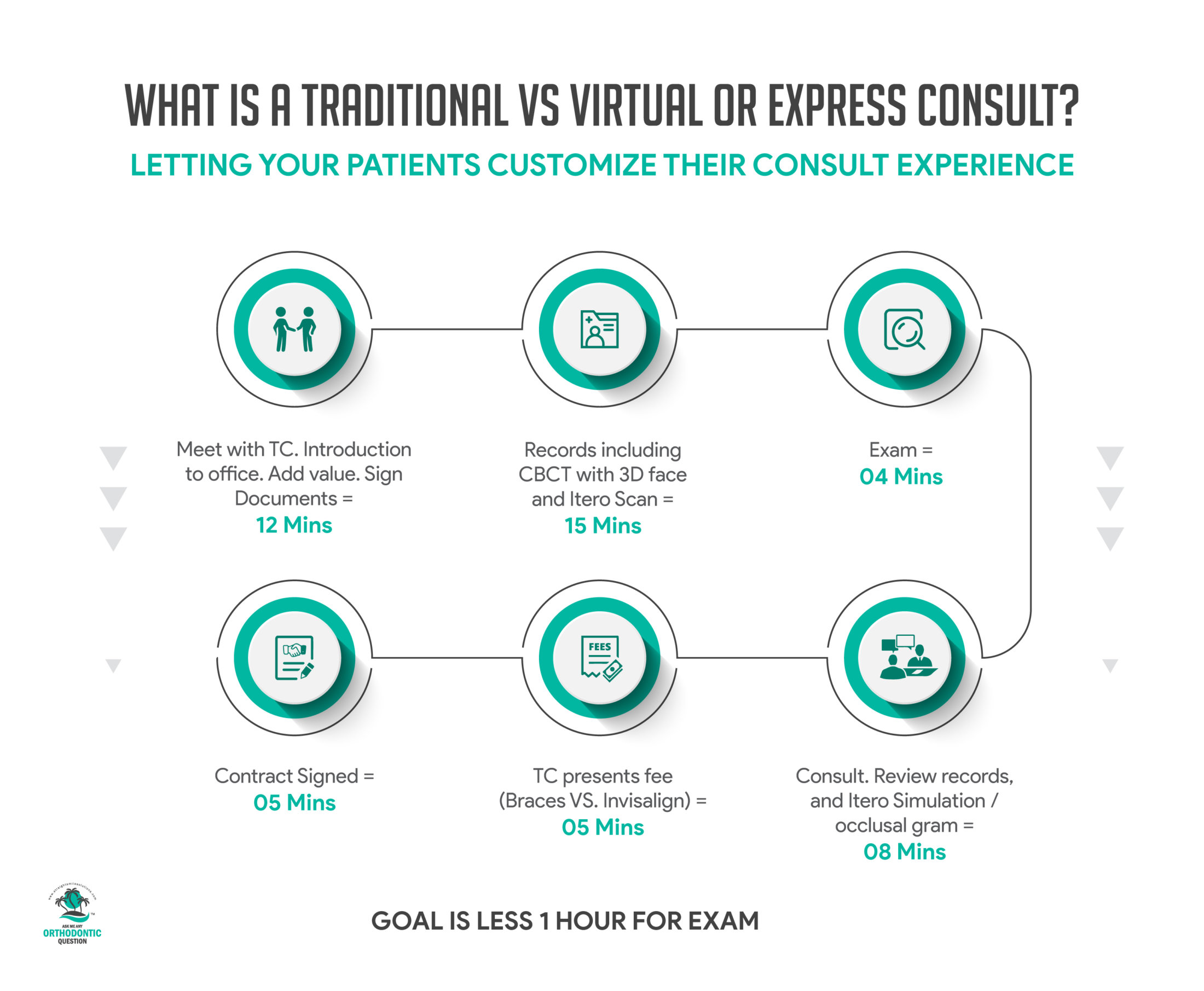
Traditional, Express, Synchronous, and Asynchronous Virtual Orthodontic Consults
Virtual orthodontic consults have become increasingly popular in recent years due to their convenience and accessibility. With advancements in technology, various types of virtual consults are available for patients to choose from.
The traditional consultation involves a tour of the office, filling out paperwork, taking records, and meeting with the orthodontist for a brief exam and simulation. The treatment coordinator then discusses treatment options and fees. The orthodontist will review the patient’s medical history, examine their teeth and jaw, and make treatment recommendations. These consults are ideal for patients who prefer a face-to-face consultation with their orthodontist.
Express virtual orthodontic consults are shorter consultations that are conducted online. Patients can fill out a form on the orthodontist’s website and submit photos of their teeth and jaw. The orthodontist will review the information and provide a treatment recommendation. These consults are ideal for patients looking for a quick and convenient way to get an initial assessment of their orthodontic needs.
Synchronous virtual orthodontic consults are conducted in real-time through video conferencing. Patients can schedule an appointment with their orthodontist, and the consultation will take place over video chat. The orthodontist will review the patient’s medical history, examine their teeth and jaw, and make treatment recommendations. Synchronous consultations use video conferencing software like Zoom.
Asynchronous virtual orthodontic consults do not require real-time communication with an orthodontist. Patients can fill out a form on the orthodontist’s website and submit photos of their teeth and jaw. The orthodontist will review the information and provide a treatment recommendation. Asynchronous consultations involve using an app or website widget to take photos and send them to the dental team. These consults are ideal for patients who want a convenient and flexible way to get an initial assessment of their orthodontic needs.
Conclusion
Virtual orthodontic consults have revolutionized the way that patients receive orthodontic care. By offering a range of options that cater to different needs and preferences, patients can receive the care they need while enjoying the convenience and flexibility of virtual consultations. The right type of virtual consult will depend on the patient’s circumstances and treatment goals, and working with a skilled orthodontist can help ensure the best possible outcome.