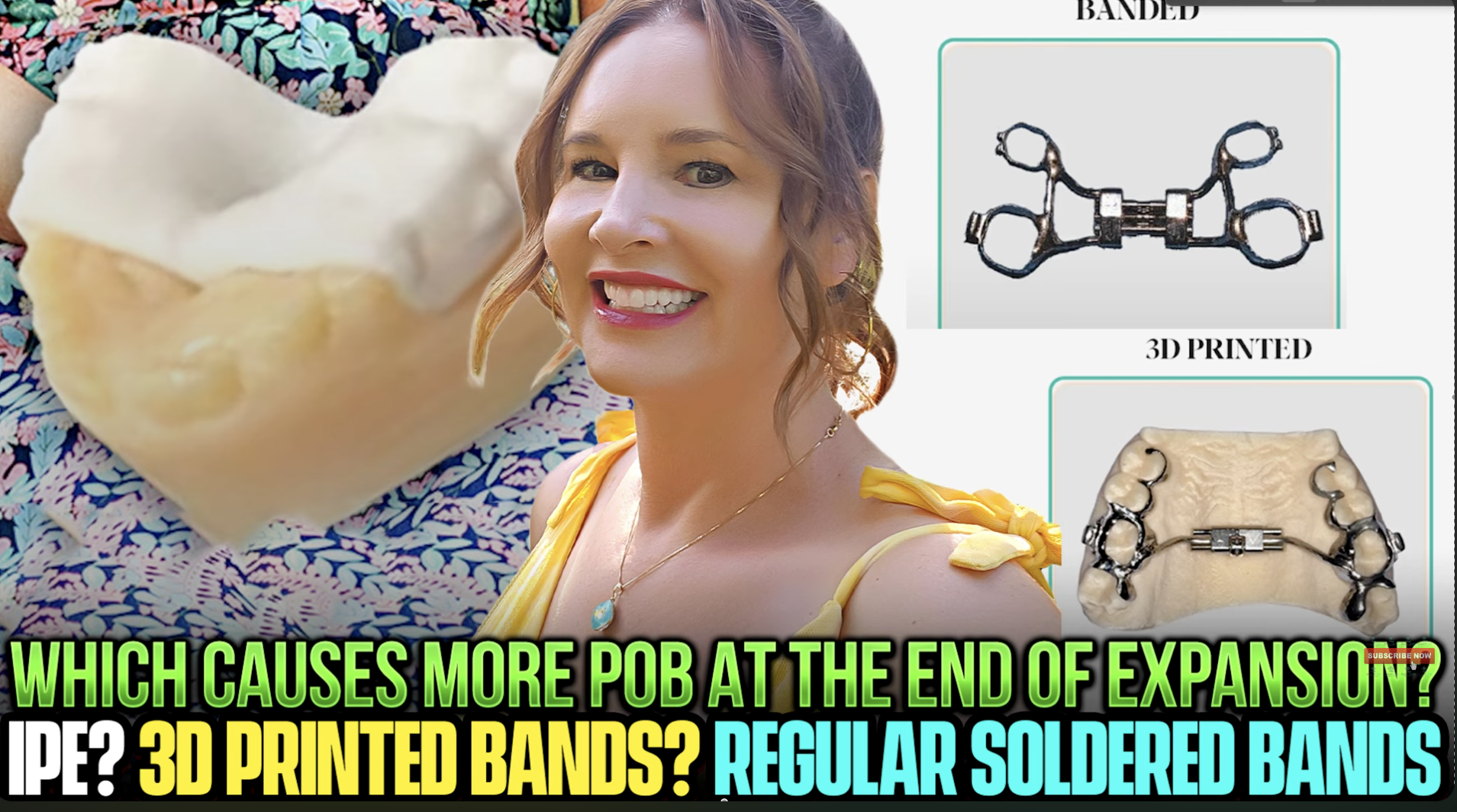
Which Makes the Worst POB (Posterior Open Bite) at the End of Expansion? RPE, IPE, or 3D Printed RME?
Dr. Amanda with Straight Smile Solutions addresses clinicians’ concerns about POBs post-expansion and reassures that this is often a normal, temporary occurrence.
Understanding Why POBs Occur
- Common Cause:
- Teeth become slightly intruded due to constant occlusal contact against thick expansion material.
- Bands, screws, or plastic components add vertical thickness → bite propped open.
- Material Thickness:
- 3D-printed RMEs and soldered band expanders are thicker than traditional banded devices.
- Repeated occlusal contact (“slam, slam, slam”) over months leads to minor intrusion of posterior teeth.
- Cuspal Interference:
- Hanging or misaligned cusps after expansion can create temporary posterior separation, appearing as open bites.
Clinical Management & Misconceptions
- Do not panic or overcorrect. POBs are typically self-resolving.
- Avoid forced eruption:
- Let gravity, occlusal settling, and muscle balance gradually close the bite.
- Forcing an eruption can cause unwanted vertical discrepancies or instability.
- Natural adaptation:
- Posterior teeth re-erupt and occlusion normalizes once the appliance is removed and function resumes.
- Reference to traditional orthodontics:
- In braces-era expansion with posterior acrylic blocks, similar POBs were common and resolved naturally during finishing.
Recommended Approach
- Allow natural settling post-expansion; avoid unnecessary mechanical intervention.
- Reassess occlusion during the retention or finishing stage, not immediately after appliance removal.
- Use deprogramming techniques (as covered in Dr. Amanda’s related content) if minor functional imbalance persists.
Key Takeaway
- All expansion types, RPE, IPE, and 3D-printed RME, can cause temporary POBs.
- The “worst” is usually linked to thicker expanders, not the expansion method itself.
- Patience > force: Nature and time resolve most posterior open bites.