
I. Introduction
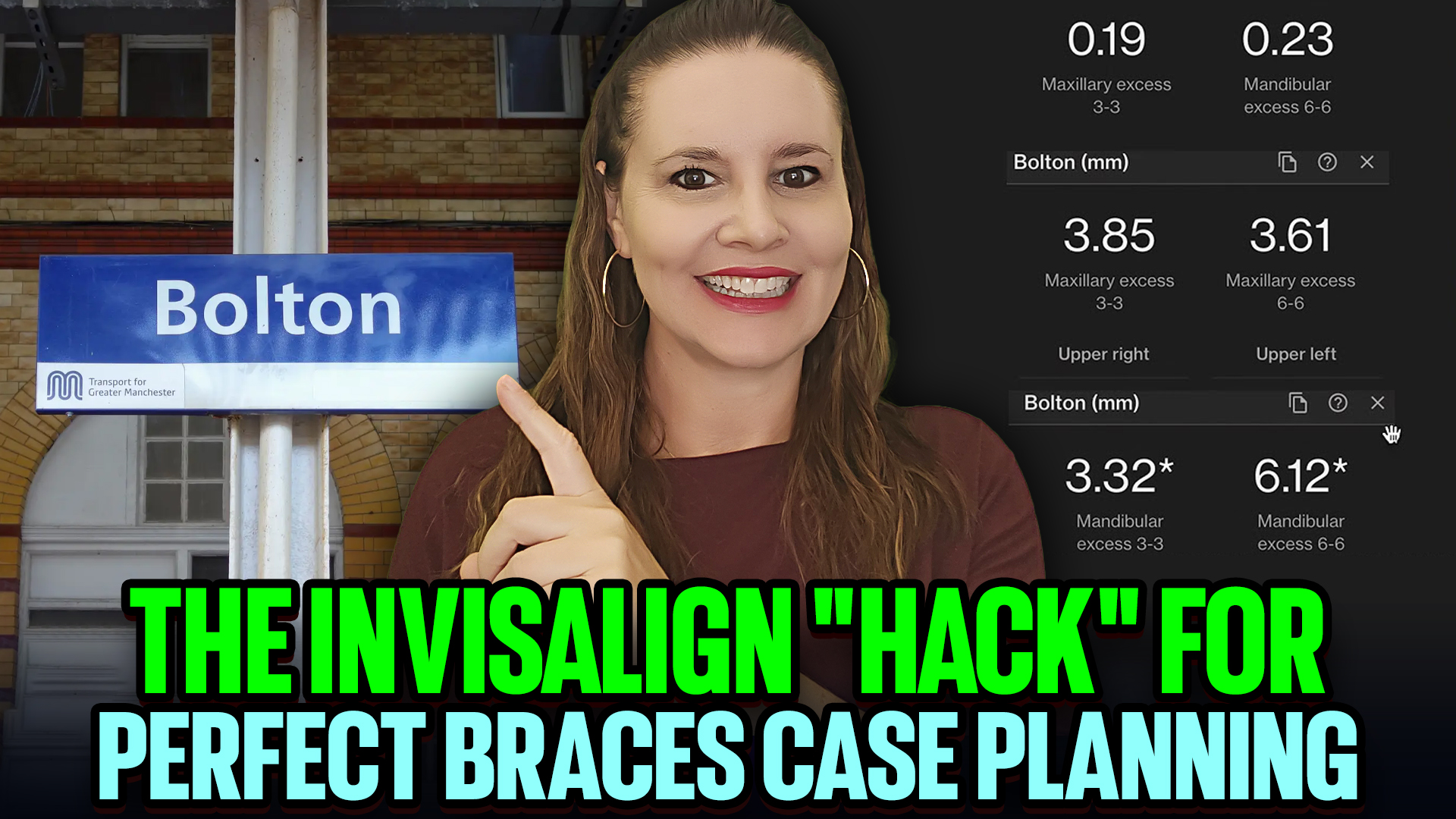
- Dr. Amanda from StraightSmile Solutions highlights one of Invisalign’s most underutilized features: the Bolton tab.
- As far as she knows, no other aligner company offers this.
- It’s a game-changer for diagnosing tooth size discrepancies even if you’re treating with braces.
II. Finding the Feature
- On a desktop: top tabs, toward the right.
- On iPad or smaller screens: hidden under sub-tabs. Find it.
- Only works if the patient has all teeth 7-to-7, no missing teeth, no baby teeth, and no incomplete impressions.
III. The Numbers: 3-to-3 vs 6-to-6
- Ignore the 3-to-3 number. It’s for anterior-only treatment (six-month smiles style).
- Dr. Amanda doesn’t recommend anterior-only treatment because the results never look good.
- Focus on the 6-to-6 number. Molar to molar. That’s the real story.
IV. Maxillary Excess vs Mandibular Excess
- Maxillary excess: The top teeth are slightly bigger than they should be.
- Result: Slight overjet. Canines stay Class I.
- Option: Add upper IPR if the patient dislikes the overjet. Optional.
- Mandibular excess: Bottom teeth are slightly bigger.
- Result: Anterior collisions, edge-to-edge occlusion, and fremitus risk.
- Action: Lower IPR is usually required. Not optional.
V. Treatment Thresholds
- 0.2-0.3mm mandibular excess? Probably fine. Light occlusion, no big deal.
- 1mm? Might offer IPR as an option.
- 2-3mm? The patient will almost always choose IPR; it’s easy, fast, and fixes the bite.
- 4mm+? Now we have a problem.
VI. Severe Bolton Discrepancies
- 6mm mandibular excess? Can’t IPR that much.
- Hours in the chair. Tooth sensitivity. Enamel loss. Unpredictable.
- Options:
- Veneers on 7-10 (or 7-10)
- Extract a lower incisor
- The magic number: Beyond 3-4mm, IPR isn’t the answer.
VII. A Critical Check: Verifying the Clincheck
- Sometimes Invisalign screws up.
- Example: 3.6mm maxillary excess, but Clincheck adds lower IPR.
- Makes zero sense in a Class I patient.
- Bolton tab catches these errors. You can push back and get it fixed.
- Never fully trust a computer. Understand the why.
VIII. The Bottom Line
- Use the Bolton tab on every Class I case.
- It tells you if IPR is needed and where it’s needed.
- Transfer that knowledge to your brace’s cases too.
- Train your eyes over time, but until then, let the software guide you.
- And always double-check. Computers make mistakes. You’re the doctor.