
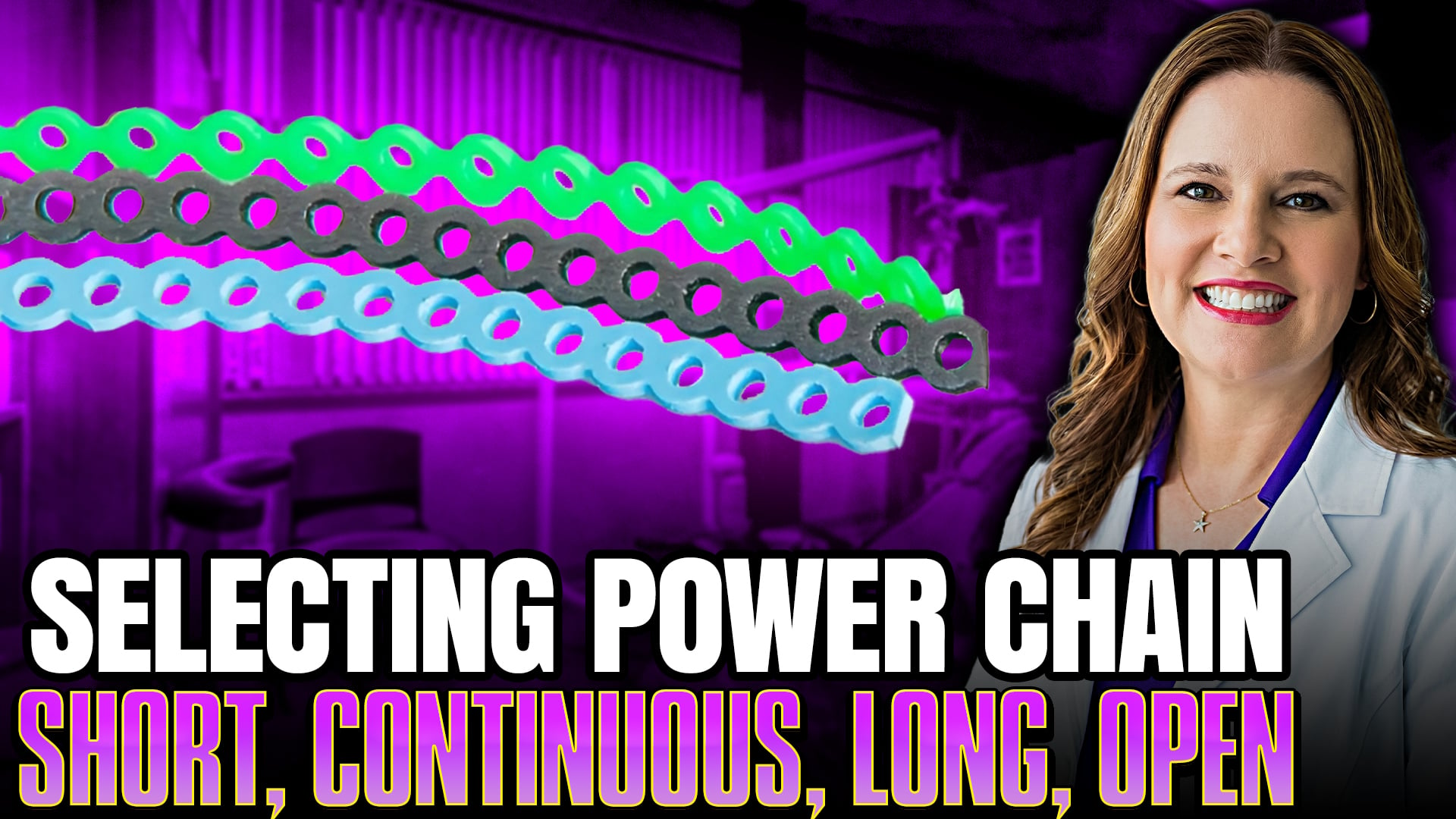
If you have braces, you might eventually hear your orthodontist mention adding a “power chain.” Unlike individual colored O-rings that hold the archwire to each bracket separately, power chains are a continuous strand of connected elastic rings. Their primary purpose is to apply continuous, uniform tension to close gaps or rotate stubborn teeth.
However, not all power chains are identical. They come in different spacing styles—typically categorized as continuous (closed), short, and long. Understanding the differences between these types helps demystify how your orthodontist is moving your smile.
Continuous (Closed) Power Chains
On a continuous or closed power chain, the elastic loops are joined directly to one another without any space or bridge between them.
- The Fit: The loops sit flush side-by-side on adjacent teeth.
- When It is Used: This style is perfect for small brackets or closely grouped teeth where you need maximum force over a short distance. It is highly effective for squeezing together remaining microscopic gaps.
Short Power Chains
Short power chains feature a very tiny link of elastic material separating each ring.
- The Fit: This slight separation accommodates the average physical space between standard-sized dental brackets.
- When It is Used: Orthodontists frequently choose short chains for standard, everyday gap closure or rotational correction on normal-sized teeth.
Long (Open) Power Chains
Long power chains have a much larger, more noticeable filament or bridge of elastic connecting each ring.
- The Fit: The loops are spaced further apart to stretch across wider distances.
- When It is Used: This style is ideal for large teeth, wider bracket spacing, or spanning across extraction sites. It delivers a lighter, more gradual pull over a longer distance.
Why Spacing Matters
Selecting the right spacing is not random. If an orthodontist uses a continuous chain on large teeth with wide brackets, the elastic will stretch too much, creating excessive force that can damage the roots. Conversely, a long chain on small teeth will be too loose to exert any useful movement.
Proper chain selection ensures your teeth move safely, efficiently, and comfortably toward your final results.