
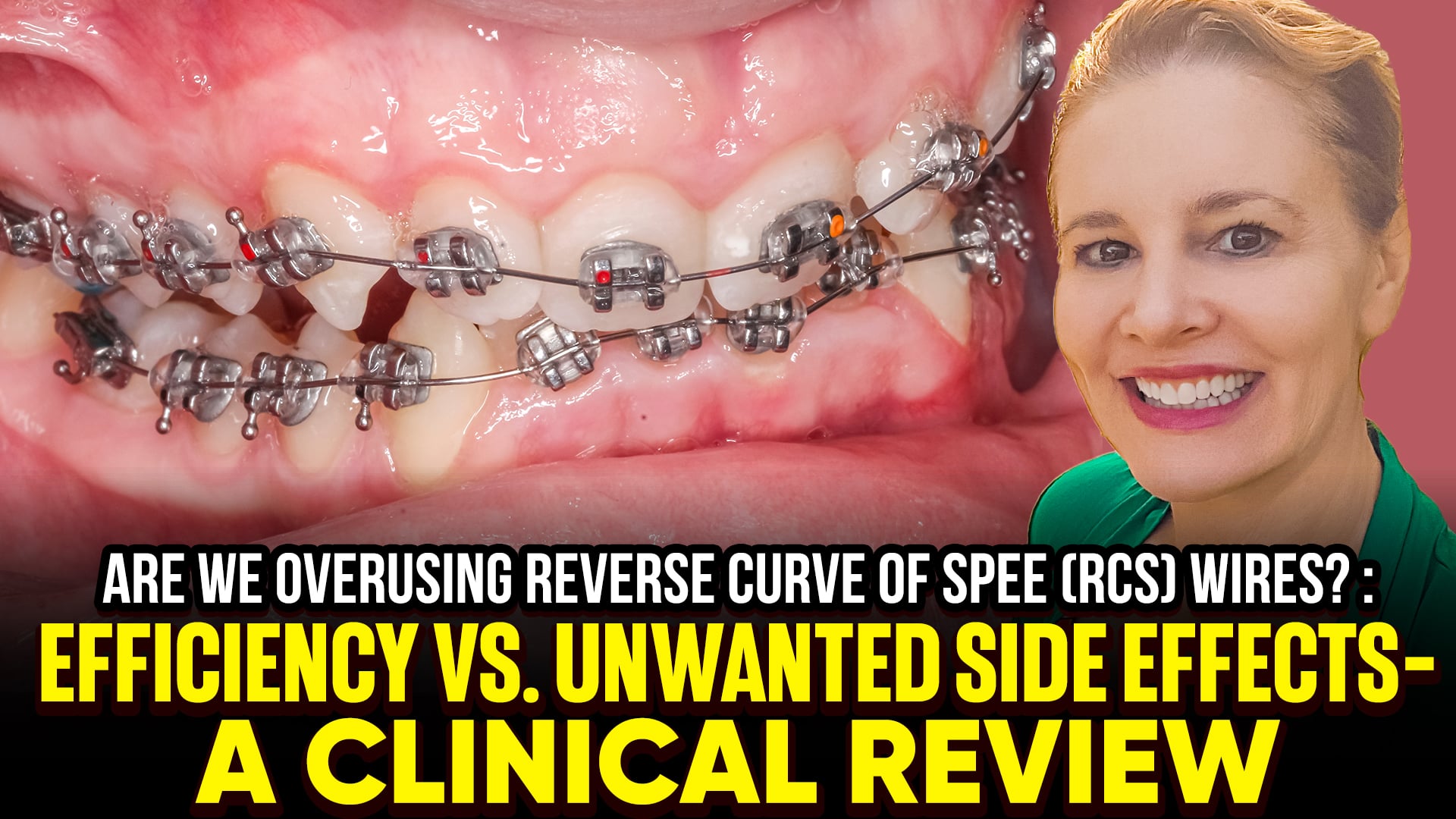
 The Dangers of Overusing Reverse Curve of Spee (RCS) Wires in Braces or Using Them at the Wrong Time
Introduction
Dr. Amanda of Straight Smile Solutions addresses the common misuse of Reverse Curve of Spee (RCS) wires in fixed orthodontic treatment. This discussion focuses specifically on lower-arch RCS wires, not accentuated Curve of Spee wires. RCS wires are often misunderstood, overused, or applied prematurely, leading to unintended side effects. Dr. Amanda emphasizes that this is an advanced topic and should be considered only after mastering straight-wire fundamentals.
When RCS Wires Become a Problem
Why RCS Wires Are Risky
Considered a “cheat” or “lazy” wire in traditional orthodontic training.
They can create uncontrolled forces, leading to unexpected reactions elsewhere in the dentition.
Improper use often opens “a can of worms” rather than solving the underlying problem.
Common Mistakes
Using RCS wires too early, before:
Full alignment and leveling
Transverse and AP correction
Root parallelism confirmed on pano
Assuming all deep bites are the same:
Upper incisor over-eruption
Lower incisor over-eruption
Posterior up righting issues
Skeletal deep bites (not orthodontically correctable)
Better Alternatives (Often Preferred)
Fixed bite plates
Intrusion arches
Bias bracketing
Posterior box elastics with bite turbos
These approaches offer more controlled and predictable biomechanics.
When RCS May Be Appropriate
Only after:
Teeth are straight (2nd molar to 2nd molar)
Overjet and spacing are ideal
Roots are parallel on pano
Used for a mild residual deep bite caused by a lower Curve of Spee.
Must be worked up gradually
Critical Safety Check
Assess for lower anterior blanching before placement.
If blanching is present, RCS use risks pushing incisors out of the bone.
Once dehiscence occurs, it cannot be reversed and may involve periodontium.
Conclusion
Reverse Curve of Spee wires are not a shortcut; they are a precision tool with narrow indications. When used too early or without proper diagnosis, they can cause irreversible damage. Proper sequencing, diagnosis, and respect for biomechanics are essential to avoid turning a small bite issue into a major problem.