
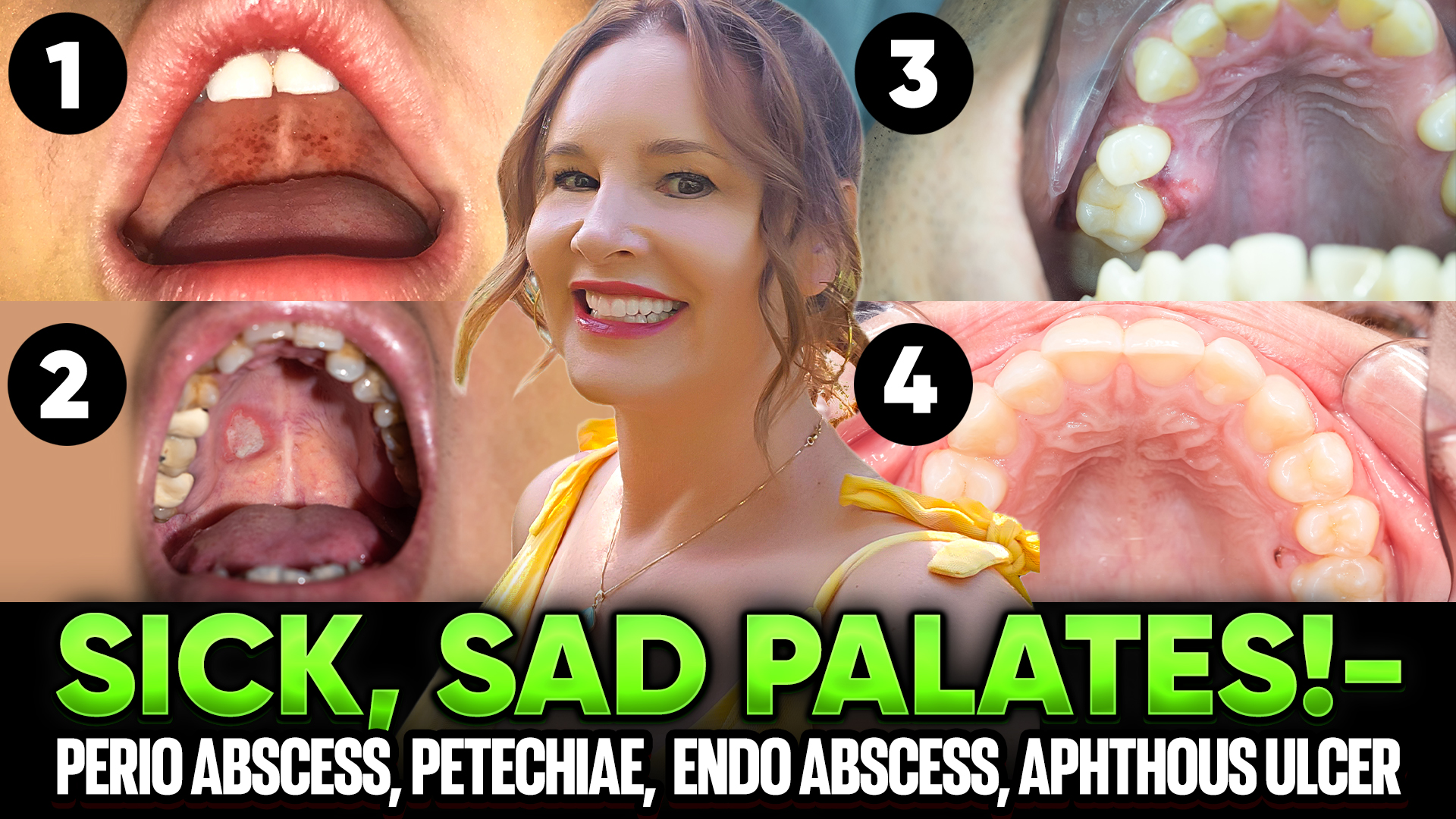
SICK PALATES! Endo & Perio Abscess, Petechiae, Aphthous Ulcers, Canker Sores
Introduction
Dr. Amanda reviews four common conditions that can appear on the palate: petechiae, aphthous ulcers/canker sores, endo abscesses, and perio abscesses. She emphasizes the importance of professional evaluation to ensure accurate diagnosis and safe management. The goal is to help clinicians distinguish trauma, immune-related ulcerations, and infections involving the teeth or gums.
- Petechiae (Trauma Bruising)
- Small pinpoint red lesions caused by trauma to the palate.
• A major warning sign of possible abuse.
• In adults, it is typically harmless but reflects recent mechanical force to the tissue.
- Aphthous Ulcers / Canker Sores
- Immune-triggered erosive ulcers appear on the palate, cheeks, or floor of the mouth, never on attached gingiva near teeth.
• Features: white or gray center, red halo, may show sloughing; does not produce pus.
• Symptoms: burning, tingling, significant pain, especially with spicy/salty foods.
• Management: avoid alcohol-based mouthwashes; use warm salt water or prescribed rinses only.
• Usually self-limiting; frequent recurrence may indicate stress or underlying health problems. Medical and psychological assessment recommended.
- Endo Abscess (Infection Inside the Tooth)
- Caused by a dead or dying tooth nerve leading to infection draining toward the palate.
• Diagnosis: vitality testing a dead tooth will not respond to cold.
• Treatment: root canal and crown or extraction if unsalvageable.
- Perio Abscess (Gum Infection)
- Infection within the supporting periodontal tissues holding the tooth in place.
• May mimic an endo abscess visually; differentiation requires X-rays and vitality testing.
• Treatment: deep cleaning, local antibiotics, and sometimes systemic antibiotics.
Conclusion
Palatal abnormalities range from simple trauma to significant infections requiring urgent care. Accurate identification depends on visual signs, symptoms, X-rays, and vitality testing. Prompt evaluation and management are essential for maintaining a healthy palate and preventing long-term complications.