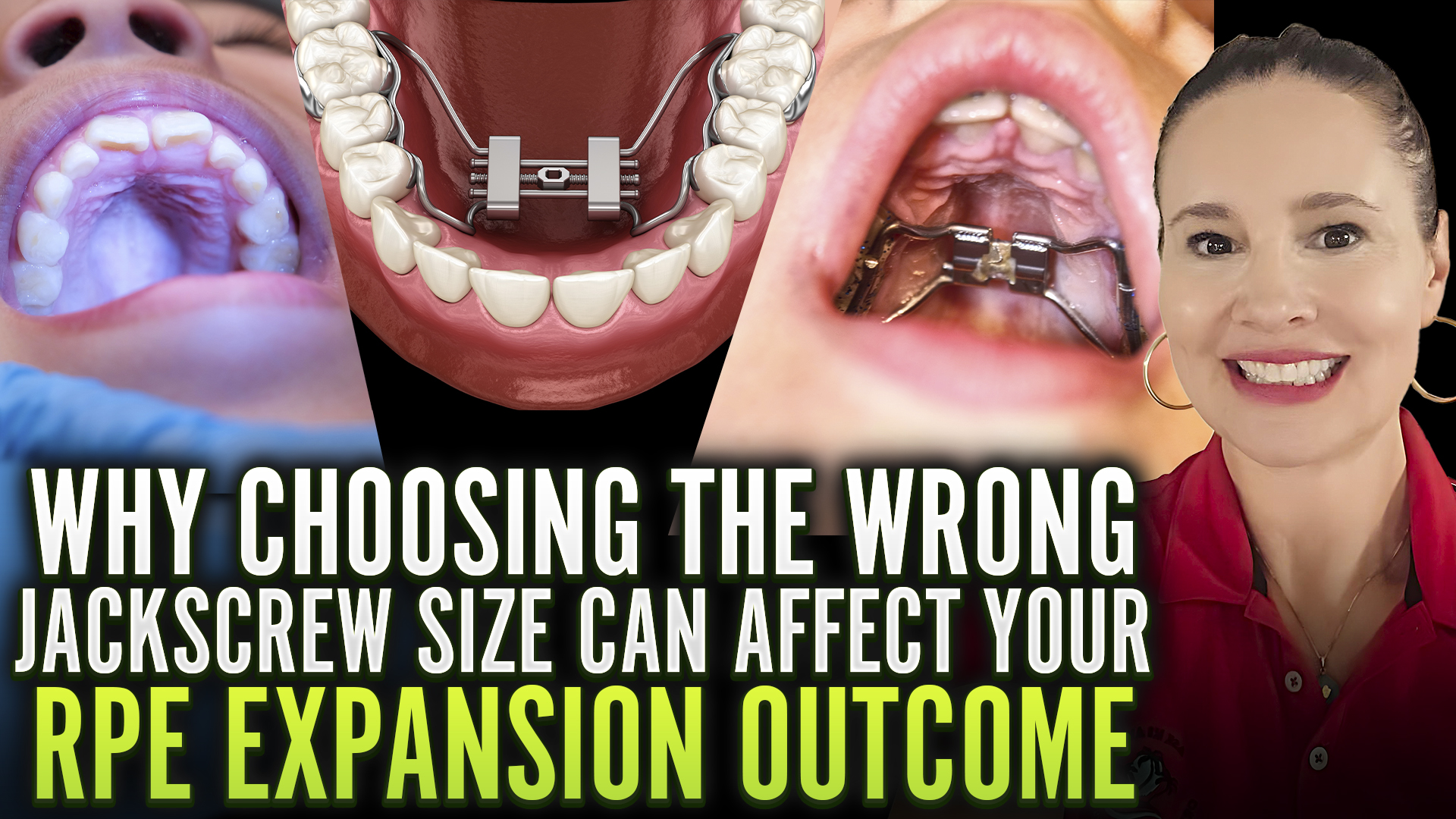
Should You Stop Expanding at 40mm with RPE/IPE?
Introduction
- Dr. Amanda from Straight Smile Solutions addresses a common question: Should expansion stop when the transpalatal width reaches 40mm?
• Many clinicians use “40mm” as a benchmark after hearing her training material, but it is not a universal stopping point.
• Tooth size, arch size, and individual anatomy mean that the ideal expansion width varies widely.
Is 40mm the Rule?
- 40mm is not a fixed stopping measurement—it’s a reference point.
• Actual final width depends on tooth size and arch proportions.
• Patients with large teeth may reach 42–48mm.
• Patients with small teeth may finish at 38–40mm.
• Range typically falls between 38 and 48mm, depending on dentofacial anatomy.
What Clinicians Should Evaluate Instead
- Instead of relying solely on a number, consider full clinical indicators:
- Overall arch form
- Tooth size and spacing
- Symmetry and stability
- Posterior crossbite correction
- Palatal vault development
• Dr. Amanda’s expansion guidelines and techniques are available in her courses and videos for deeper case review.
Why Overexpansion Matters
- Slight overexpansion is preferred to avoid relapse.
• Under correction risks arch collapse and retreatment.
• Some relapse is expected; expansion must account for this.
Clinician Guidance
- Don’t stop just because the caliper reads 40mm.
• Review functional and structural goals:
- Stable occlusion
- Proper arch coordination
- Skeletal correction vs. dental tipping
• If uncertain, Dr. Amanda encourages doctors to email or review her course material for step-by-step criteria.
Conclusion
The “40mm rule” is a guideline, not a finish line. True expansion success depends on overall anatomy, tooth size, and clinical stability, not just a single number. When in doubt, aim slightly beyond the visible target to ensure long-term retention and avoid relapse. Expansion should stop when biomechanics and function confirm stability, not when a ruler says so.