
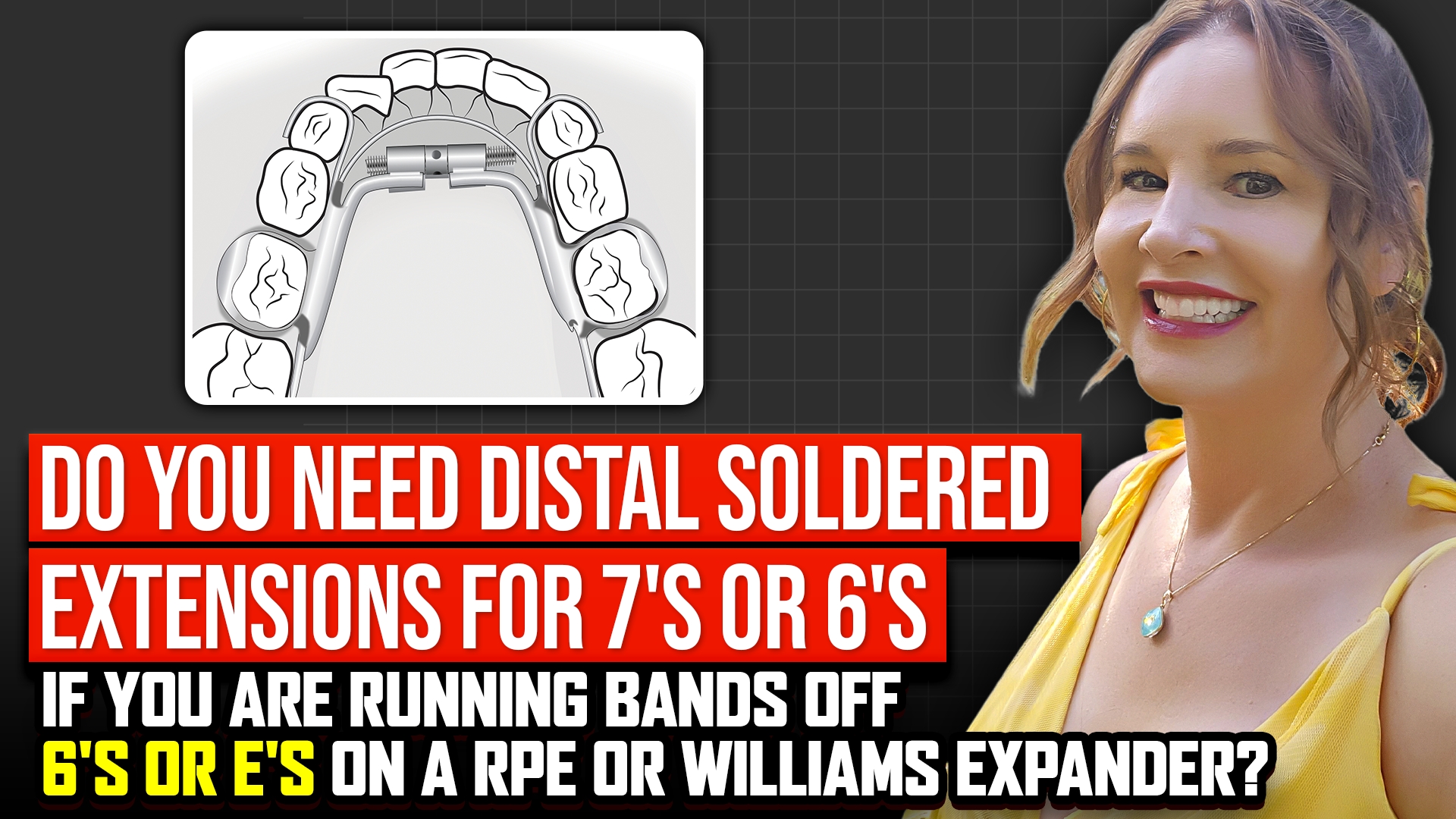
Should You Solder Distal Extensions on Your RPE or Appliances for 6’s and 7’s?
I. Introduction
Dr Amanda from StraightSmile Solutions answers a common lab question: Should you add soldered distal extensions to an RPE or expander to engage the first or second molars?
The answer: it depends on your finishing plan, the patient’s age, and the appliance type.
II. The Case for Distal Extensions
Extensions can help keep molars travelling with the expansion, preventing them from lagging.
If you plan to finish the case in braces, getting a band on a wonky second molar is a nightmare. Extensions may reduce that headache.
Some labs automatically add them; others require a request. Cost is minimal (~$5-10 per case).
III. The Case Against Distal Extensions
Extensions add bulk, making the appliance more annoying for the patient (more wax, more irritation).
If you are finishing with Invisalign, you can easily pick up any mildly rotated molars later – extensions are unnecessary.
In pre-pubertal patients doing true skeletal expansion, the molars should travel with the expander anyway. If they don’t, that’s a different problem.
IV. Age and Arch Considerations
Upper arch: In a growing child, proper expansion separates the midpalatal suture; molars should move with the appliance.
Lower arch: Expanders only upright the curve of Spee molars, may not track perfectly, so that extensions might help.
For very young children (expand on E’s), be cautious about stressing primary teeth.
V. The Bottom Line
Distal extensions are optional, not required.
Use them if you are finishing with braces and want to minimise wonky molars.
Skip them if you are finishing with Invisalign aligners, which can fix minor rotations easily.
Discuss with your lab and weigh patient comfort vs mechanical benefit.