
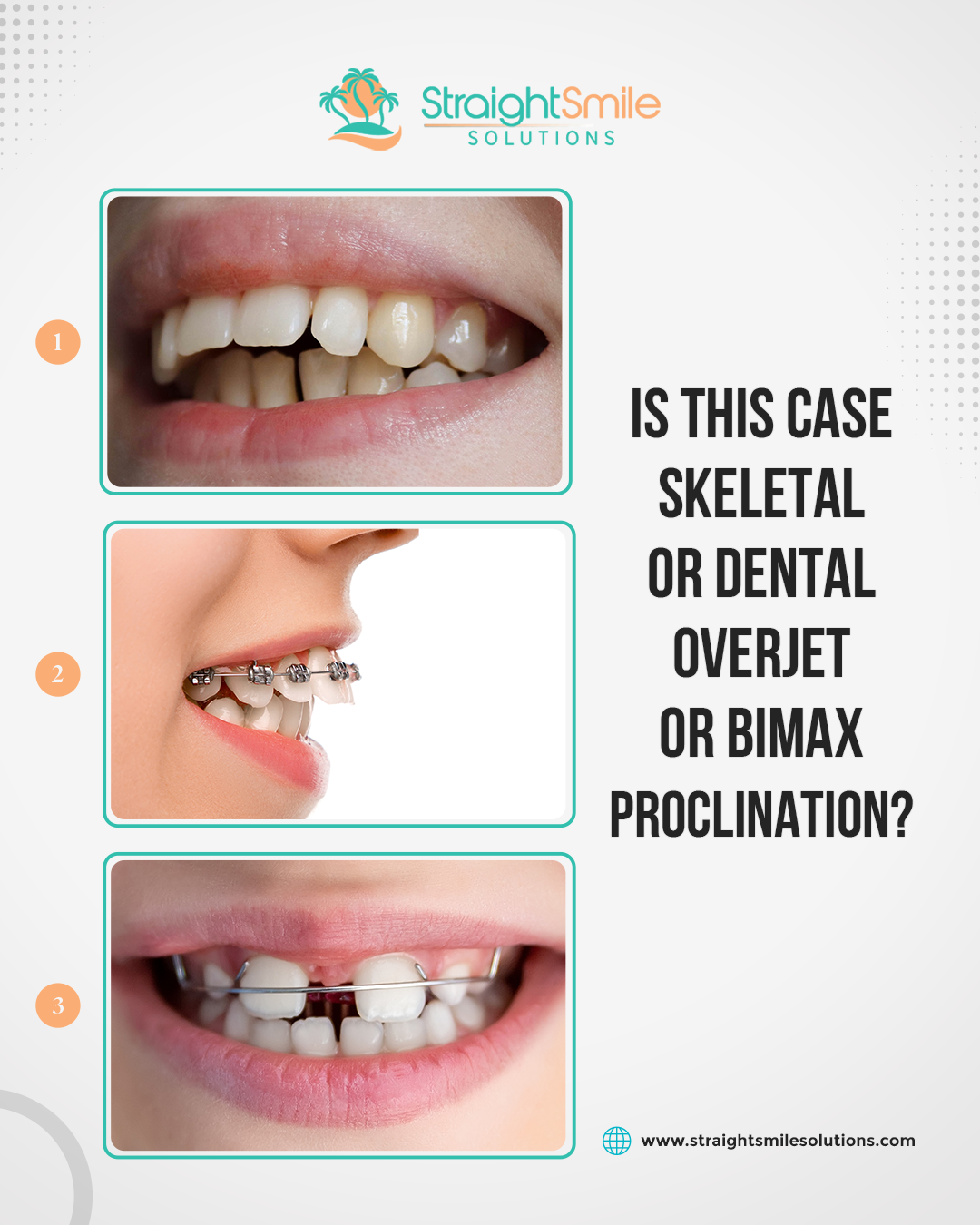
Proclination, Bimax, and Overjet DEFINED for Braces and Invisalign
Introduction
A lot of people, including doctors and ads online, incorrectly mix terms like overjet, overbite, proclination, and bimax. This confuses treatment planning. Here are the proper orthodontic definitions—no shortcuts, no slang.
Overjet
- Refers to teeth, not jaws.
- Means the upper front teeth sit ahead of the lower front teeth.
- Not the same as Class II. You can:
- Have overjet without Class II
- Be Class II without overjet (e.g., Class II div 2)
- Function rule:
- Front teeth should not touch at rest
- They should touch in function (chewing/bite movements).
- Measured at the most protruded tooth, not always the same value across incisors.
Proclination
- Refers to tooth inclination relative to the bone, not tooth-to-tooth relationship.
- Proclined incisors = teeth angled forward out of the jawbone more horizontally than ideal.
- Determined on ceph analysis (incisor angle/position).
- Example idea: more “driving outward” vs. vertical emergence.
Bimaxillary Protrusion (Bimax)
- Refers to both jaws, not the teeth.
- Both the maxilla and mandible sit more forward on the face (higher SNA & SNB).
- Often associated with:
- Fuller lips/soft tissue profile
- Usually good airway
- Not a bad thing — just a skeletal pattern. Not the same as “proclined teeth.”
Conclusion
- Overjet = tooth-to-tooth relationship
- Proclination = tooth-to-bone position
- Bimax = jaw position in the skull
To diagnose correctly, always label whether a condition is skeletal or dental, because both can differ. Correct terminology = correct treatment planning.