
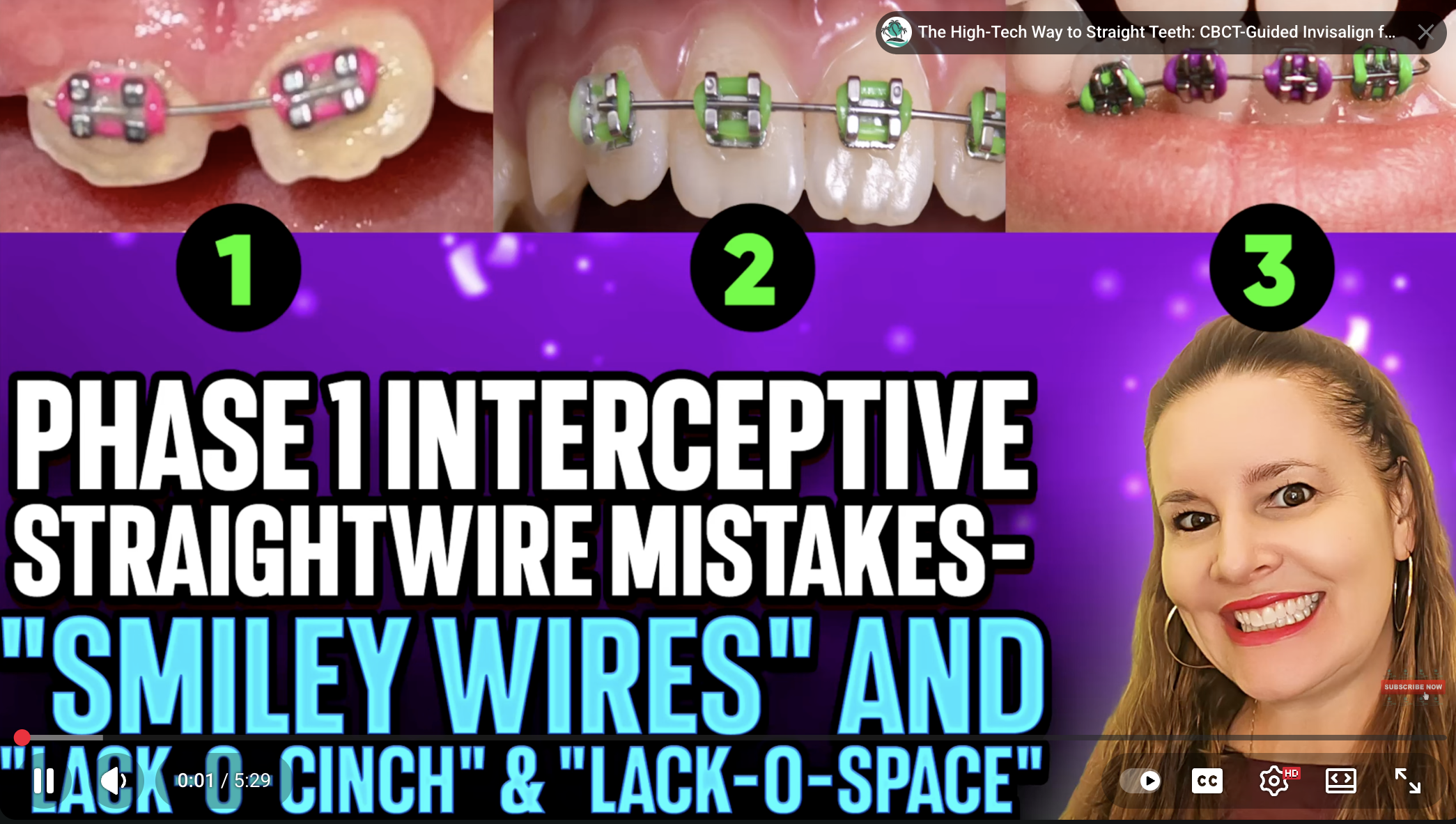
Phase 1 Interceptive Straightwire Mistakes: “Smiley Wires,” “Lack-o-Cinch,” “Lack-o-Space”
Introduction
Dr. Amanda reviews common mistakes clinicians make when using segmental straightwire mechanics in Phase 1 interceptive orthodontics. She emphasizes that the Phase 1 straight wire is very different from standard straight wire or comprehensive braces. She also recommends taking her Phase 1 course or watching her Phase 1 playlist to avoid procedural errors. Focus of the video: identifying three key mistakes, Smiley Wires, Lack-o-Cinch, and Lack-o-Space, and understanding why they cause treatment failure.
Smiley Wires (Cinch Error)
- A “smiley wire” happens when the clinician forgets to cinch the wire or the cinch breaks/slides.
- Round wires rotate easily; without proper cinching, they flip upward and distort the archform.
- Result: the arch looks “smiley” on one side and flat on the other, unbalanced and unstable.
- A flipped wire can push teeth buccally, sometimes severely enough to risk pushing roots outside the bone.
- Segmental 2×2 or 1×1 setups are especially vulnerable because they lack adequate anchorage.
- If a cinch error is ignored, the tooth can self-extract or become dangerously displaced.
Lack-o-Cinch (Incomplete Securement)
- Occurs when the wire is not fully seated, secured, or stabilized.
- Leads to uncontrolled wire rotation and unintended tooth movement.
- Cutting the wire after it has slid can worsen the distortion and accelerate buccal displacement.
- Proper anchorage and securement are essential for any segmental setup.
Lack-o-Space (Bracketing with No Space)
- Bracketing teeth in an arch without sufficient space is ineffective and can damage underlying permanent teeth.
- Interceptive brackets cannot create space when multiple baby teeth remain, and roots of permanent teeth are still developing.
- For Phase 1, expansion must precede bracketing.
- Dr. Amanda recommends 1.5-2 mm of extra space per tooth, plus additional room for eruption. Often, a space of 4-7 mm is missing when errors occur.
- Expansion devices (not braces) should be used first to avoid pushing on unstable or loose baby teeth.
Conclusion
Phase 1 straightwire requires precise mechanics, space creation, and proper cinching. Avoiding these three mistakes prevents complications, protects erupting teeth, and leads to predictable results.