
Introduction
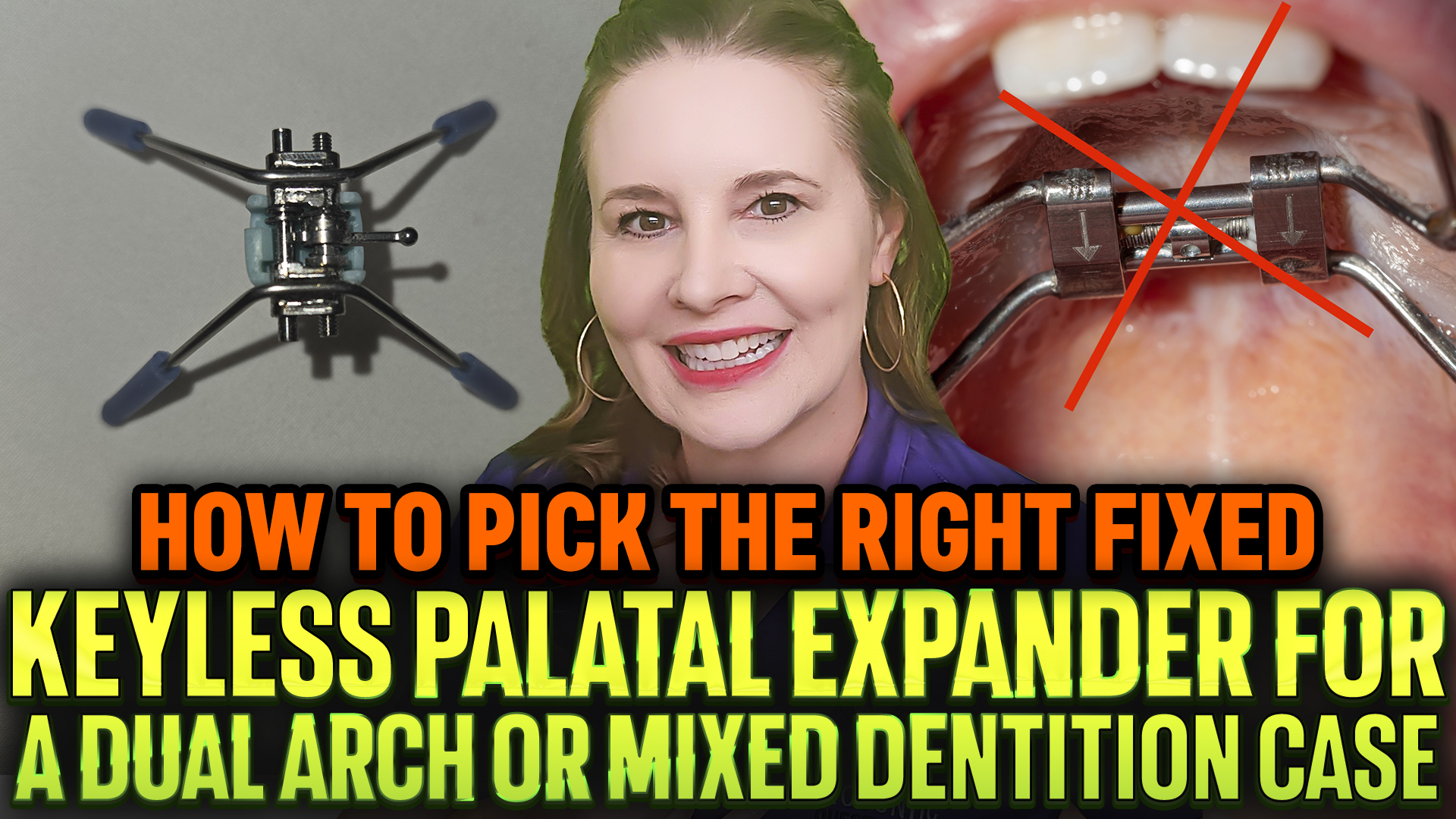
Dr. Amanda from Straight Smile Solutions follows up on her original discussion about keyless expanders to clarify an important clinical distinction: not all keyless palatal expanders are the same. In Part 2, she focuses specifically on fixed keyless RPE/RME options for dual-arch and mixed dentition cases, explaining why appliance control, activation timing, and liability are important considerations when selecting between leaf expanders, W-arches, quad helices, and button-activated keyless expanders.
Key Clinical Considerations
Fixed vs Removable Keyless Expanders
-
- This discussion applies to fixed appliances only
- Removable options (e.g., IP) can work, but are bulky and higher cost
- Lower-cost fixed options improve access for more patients
Categories of Keyless Expanders
Button-activated keyless expanders (e.g., KKE)
Clinician-controlled activation
Adjustable rate and frequency
Comparable to a Hyrax but without a key
Leaf expanders
Pre-programmed, spring-driven expansion
Cannot be reversed or paused
Limited flexibility once activated
W-arches / Quad Helices
Continuous, uncontrolled force systems
Expansion continues unless the appliance is removed
Why Control Matters
-
- Dual-arch and mixed dentition cases require coordination
- Uncontrolled expansion risks:
Over-expansion
Brodie bite/scissor bite
Upper arch outgrowing the lower
Occlusal trauma and instability
-
- Fixed appliances that “keep expanding” create liability if appointments are missed
Clinical Experience & Risk
-
- Overextended quad helix cases can cause severe occlusal damage
- Once an uncontrolled appliance is placed, monitoring is mandatory
- If something goes wrong, responsibility lies with the doctor, not the staff
Why Dr. Amanda Prefers Controlled Keyless Systems
-
- Same activation logic as a traditional key
- Expansion can be slowed, paused, or customized
- Better suited for mixed dentition and dual-arch treatment
Conclusion
Keyless does not automatically mean safer or better. Dr. Amanda emphasizes that control is the defining factor when choosing a palatal expander. While leaf expanders and W-arches are valid tools in select cases, uncontrolled expansion carries real clinical and legal risks, especially in mixed dentition and dual-arch treatment. Understanding the risks, benefits, and alternatives enables clinicians to select the appropriate appliance for each patient, thereby protecting both patient outcomes and liability.