
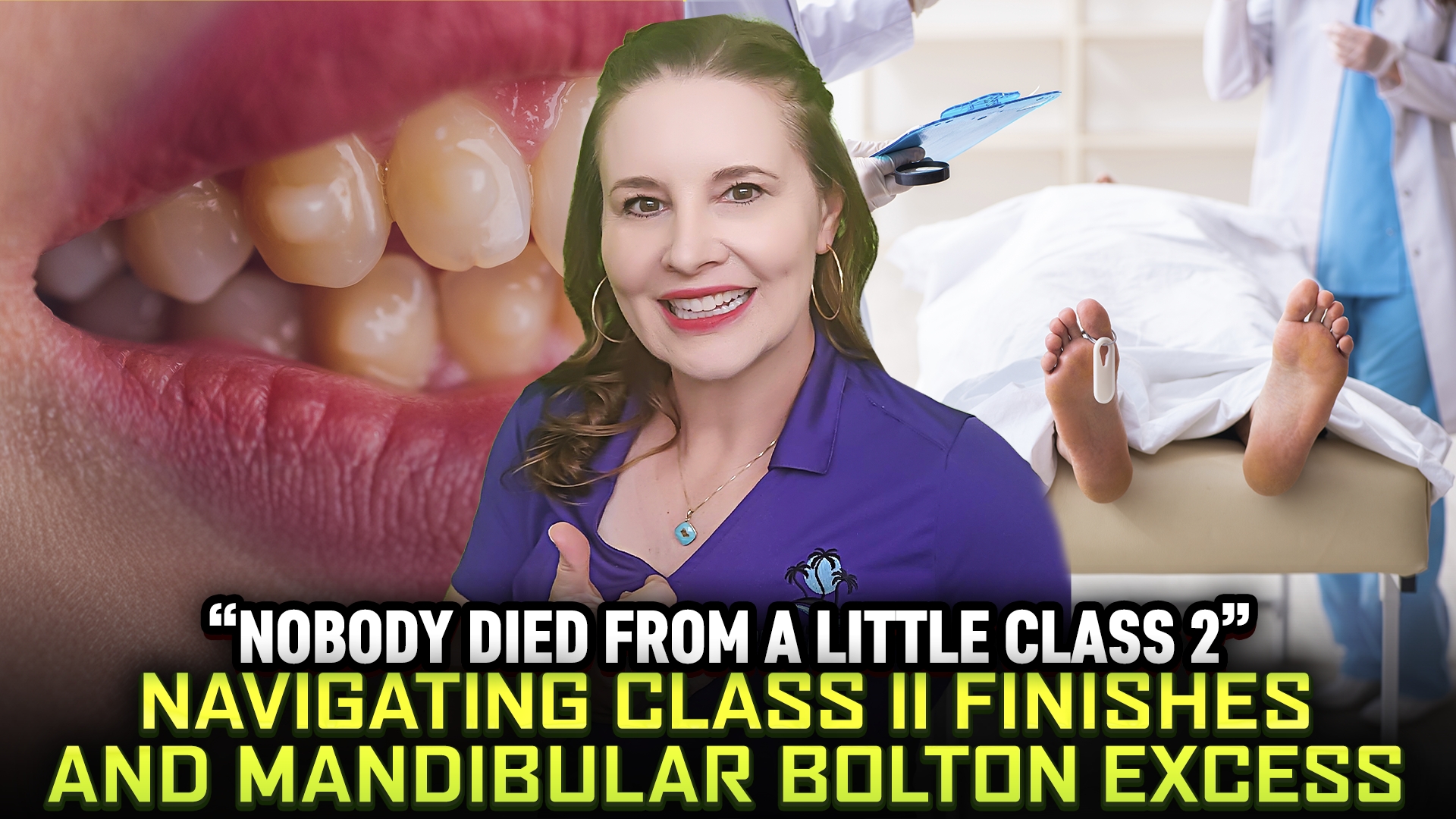
 “Nobody Died from a Little Class 2 Malocclusion” – The Truth and Risks of Over-Treatment
I. Introduction
● Dr. Amanda from StraightSmile Solutions addresses those subtle Class II cases—just a millimeter or two off on canines or molars.
● Sometimes a little elastic work works. Sometimes it doesn’t.
● And sometimes, the best move is to leave it alone.
II. When to Leave It: The Professor’s Wisdom
● Back in residency, one of Dr. Amanda’s professors said something that stuck: “Nobody died from a little Class II.”
● It’s true. A slight Class II isn’t a medical emergency.
● A slight Class III? Different story—zero canine guidance creates real functional issues.
● But a minor Class II? Who cares?
III. The Bolton Factor
● Always check for Bolton discrepancies before chasing perfection.
● In a subtle Class II, you might not know until you measure.
● Modern software makes Bolton calculations easy before you even start.
● If there’s a mandibular Bolton excess, forcing a Class I result can leave anterior contacts causing trauma, fremitus, and perio problems down the road.
IV. Profile and Incisor Position Matter
● Run the cephalometrics. What are the incisors doing?
● If they’re already upright, correcting that minor Class II means retroclining them further.
● That worsens the profile. It worsens the E-line.
● Trading a beautiful face for a textbook occlusion? That’s not a win.
V. The Heroic Mechanics Trap
● Trying to distalize molars into perfect Class I often requires:
● Two to three years of treatment
● Heroic mechanics that burn out roots
● Lower IPR that compromises enamel
● Restorations on front teeth afterward
● All for what? A photo in a textbook?
● That’s not excellent care. That’s borderline malpractice.
VI. The Board Case Problem
● Dr. Amanda calls out the optional orthodontic board certification process.
● The pursuit of “perfect finishes” for boards leads clinicians to put patients through years of unnecessary treatment.
● Cases get comped because roots get wrecked. Long-term outcomes suffer.
● Just because some “named angel” made a rule about what occlusion should look like doesn’t make it right for the patient.
VII. The Bottom Line
● A millimeter or two of Class II is not a disease.
● It doesn’t need curing.
● Forcing perfection creates real damage—root resorption, restored teeth, compromised profiles.
● Nobody died from a little Class II. Stop treating them like they did.