
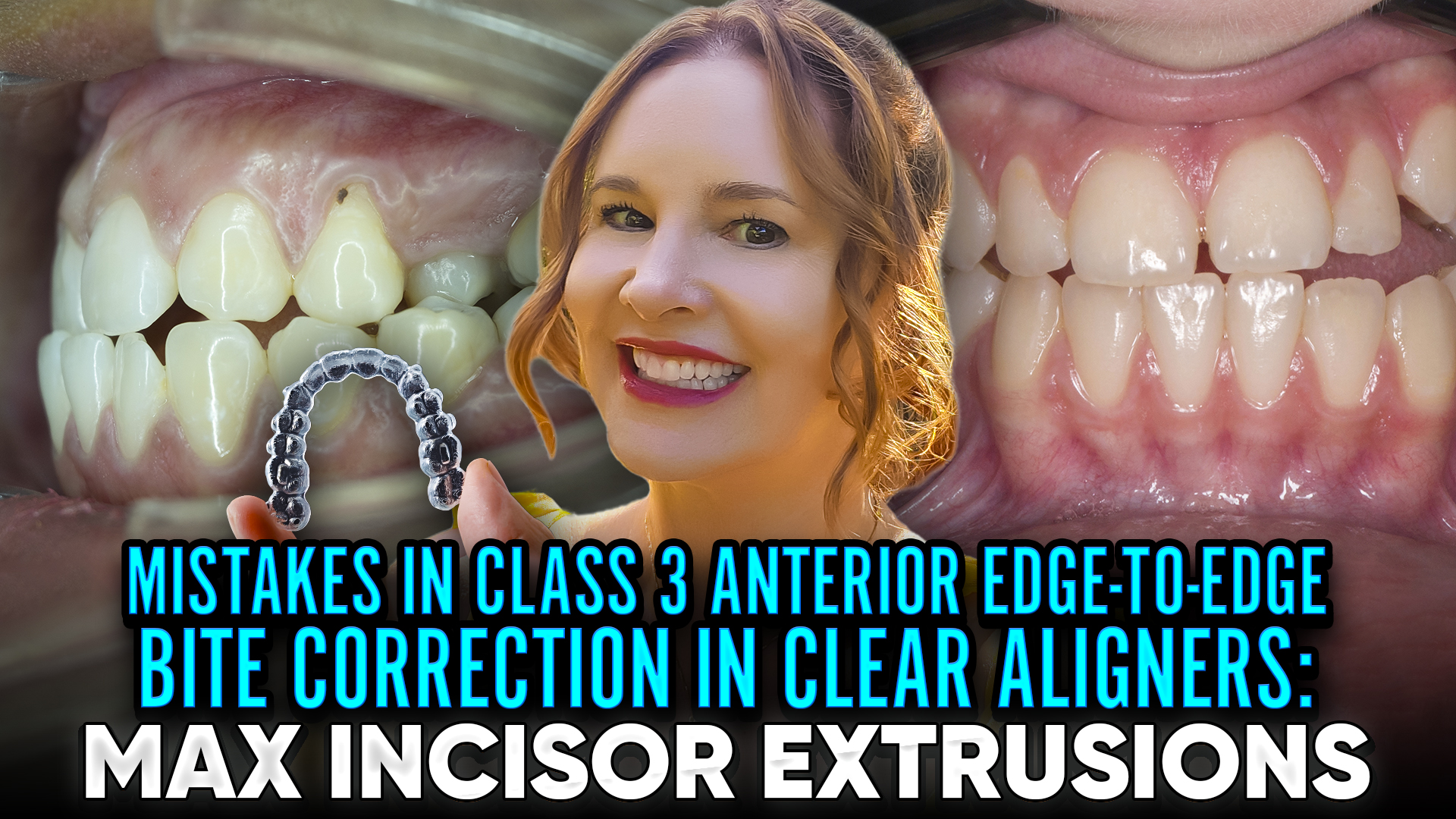
Mistakes in Edge-to-Edge Class III Adult Treatment Planning: Why Invisalign Incisor Extrusions Are Hocus Pocus
Introduction
Dr. Amanda highlights the most common mistakes clinicians make when planning treatment for adult Class III, edge-to-edge, or borderline Class III Invisalign cases. These errors often come from skipping diagnostic imaging, misunderstanding incisor position, or relying on automated “AI-bot” setups instead of guiding the plan with real orthodontic principles. She explains why these shortcuts lead to unrealistic movements, especially incisor extrusion “magic,” and how proper records prevent bone, stability, and aesthetic problems.
Why Mild Class III/Edge-to-Edge Cases Get Mishandled
- Many borderline Class III cases only require lower IPR to correct the bite.
- Instead, clinicians try to avoid IPR and hope software will “fix it.”
- Failing to check Bolton ratios, angulation, and sagittal relationships leads to incorrect assumptions about whether the case is even solvable without space management.
The Critical Role of Cephs and CBCTs
- A ceph shows incisor angulation relative to the cranial base, maxilla, soft tissue, and facial harmony.
- A CBCT only shows bone availability, not whether a movement is aesthetically or functionally appropriate.
- Without these diagnostics, clinicians cannot know whether incisors should be flared, uprighted, or maintained.
The “AI Cookie-Cutter Bot” Problem
- If you don’t give explicit instructions, the aligner company’s engine will attempt “Hocus Pocus” movements, typically extruding and flaring incisors to compensate for AP discrepancy.
- These movements push teeth out of bone, compromise periodontal health, and create unstable outcomes.
- Automated setups are not customized and lack clinical accountability; they produce outcomes that “look magical” but fail in real mouths.
Conclusion
Successful adult Class III and edge-to-edge cases require planning, proper imaging, and clear treatment directives, rather than reliance on automated setups. Cephs and CBCTs guide whether space, IPR, or controlled incisor movements are appropriate. Avoiding diagnostics and letting software improvise leads to unrealistic “magic tricks” that risk bone and stability. Thoughtful clinician-driven planning is essential for safe and predictable Class III correction.