
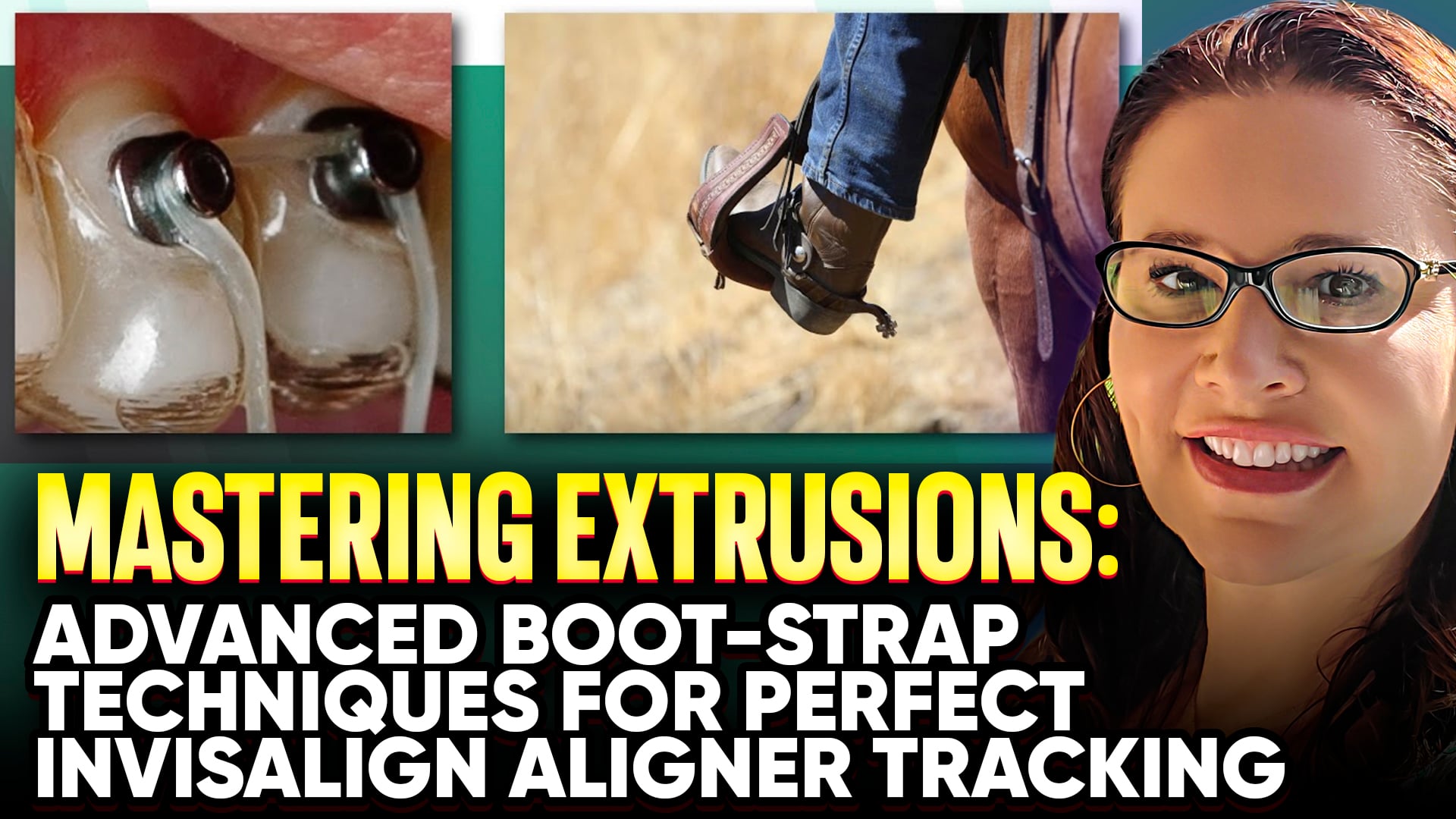
Dr. Amanda breaks down the realities behind using the bootstrap technique for extrusion within Invisalign cases. Although widely discussed, it is far from her preferred method and is useful only in rare, highly specific scenarios. She emphasizes that extrusion is one of the most difficult movements with aligners, and bootstrapping should never be the first solution. Instead, it is a last-resort, stopgap technique reserved for urgent situations or when all other predictable options, especially refinement, are unavailable.
When the Bootstrap Technique Is Actually Appropriate
- Ideal only when one single tooth needs extrusion.
- The rest of the case must be fully finished and stable.
- There must be adequate vertical and proximal space, with no contacts blocking movement.
- A second scenario: the patient is traveling and cannot be rescanned for refinement, and no previous aligners are available for backtracking.
Critical Pre-Checks Before Bootstrapping
- Perio stability must be confirmed; excessive force risks permanent damage.
- Evaluate whether the tooth is conical, rotated, or short-rooted; these respond unpredictably.
- Ensure there is a plan for firm long-term retention, as extruded teeth relapse easily.
Practical Challenges
- Patients struggle with placing elastics; they often need tweezers or specialized tools.
- Elastic selection varies depending on tooth size and orientation; no universal answer.
- Clear buttons are bulky; metal-bonded hooks perform far better.
- Most patients will dislike the appearance and inconvenience. Only highly motivated patients tolerate the process.
Creative Workarounds
- In rare cases, a small piece of power chain can replace an elastic if sized correctly.
- Works best on cooperative family members (“sofa orthodontics”), not typical patients.
Conclusion
Bootstrapping can work, but only in narrow, highly controlled situations involving a single stubborn tooth and no time for refinement. It demands careful diagnostics, patient skill, and cautious force application. Ultimately, it is not a standard technique, but rather a temporary lifesaver when all predictable aligner options are unavailable.