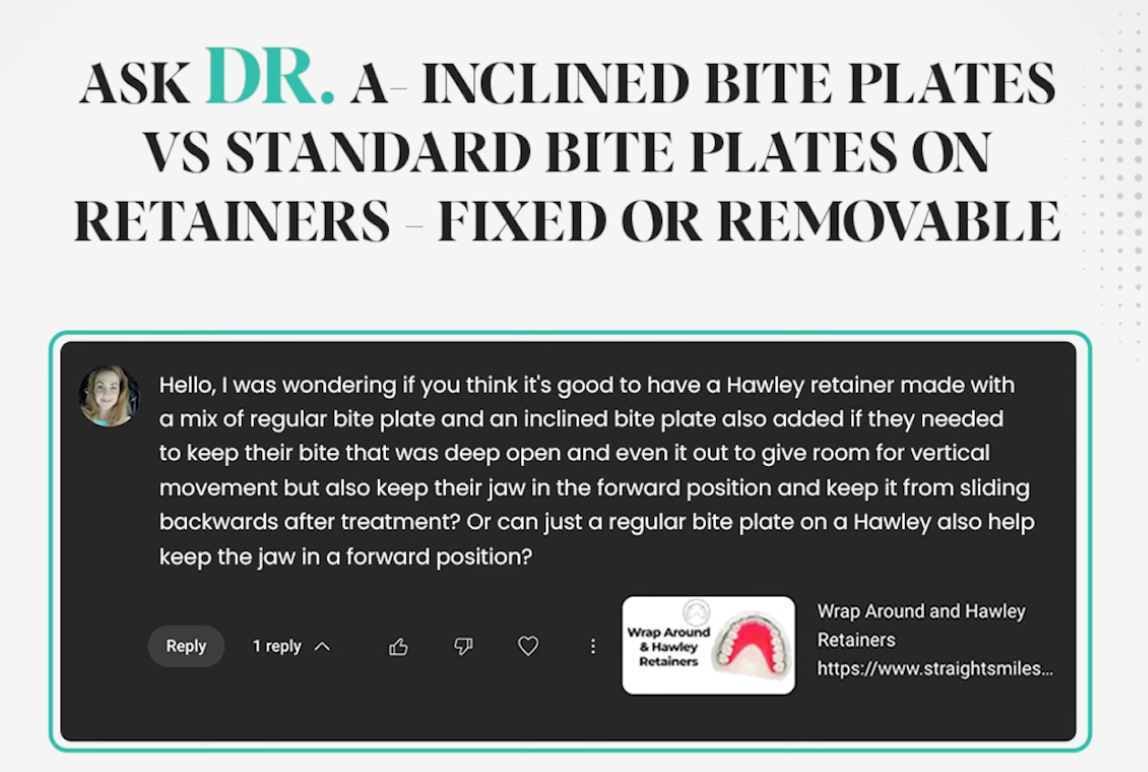
Inclined Bite Plates – Fixed and Removable Retainers for Class II
Introduction
- Dr. Amanda addresses a common orthodontic question regarding inclined bite plates versus standard anterior bite plates, applicable in both fixed and removable retainers.
- Focus: their role in correcting deep bites and managing Class II cases, along with when they may or may not be effective.
Understanding Bite Plates
- Types of bite plates:
- Inclined bite plates (upper or lower).
- Removable bite plates.
- Fixed anterior bite plates.
- Literature on this topic is limited, though some orthodontic research provides general insights into their effectiveness.
- Inclined designs add a ramp-like element, but the difference from standard plates is relatively minor.
Effectiveness and Limitations
- Inclined bite plates may not make a significant difference compared to standard anterior bite plates.
- They generally do not cause harm, so can be considered as an option.
- Effectiveness depends heavily on the patient’s growth stage and treatment goals.
Patient Age and Growth Considerations
- Older teens nearing the end of puberty:
- If significant overjet (e.g., 4mm) remains, inclined plates will not stimulate jaw growth.
- Options at this stage are limited to camouflage treatments or jaw surgery for true correction.
- Younger patients’ post-phase one:
- With growth potential remaining, inclined bite plates may be useful if compliance is good.
- They offer a non-invasive adjunct, though not a growth modification tool.
Alternatives and Enhancements
- Rickonator appliance:
- Functions as an incline bite ramp with a built-in ledge.
- More effective than a plain incline because it gives a tactile “resting point” for lower teeth.
- Encourages better compliance and functionality.
- Dr. Amanda suggests these can be more reliable than standard inclined bite plates.
Conclusion
- Inclined bite plates are a low-risk option but have limited effectiveness in jaw growth correction.
- Best suited for younger patients with growth remaining; less effective in older teens.
- Alternatives like the Rickonator may provide better control and outcomes.
- Ultimately, clinicians should consider patient age, growth stage, and treatment goals when selecting retainer designs.