
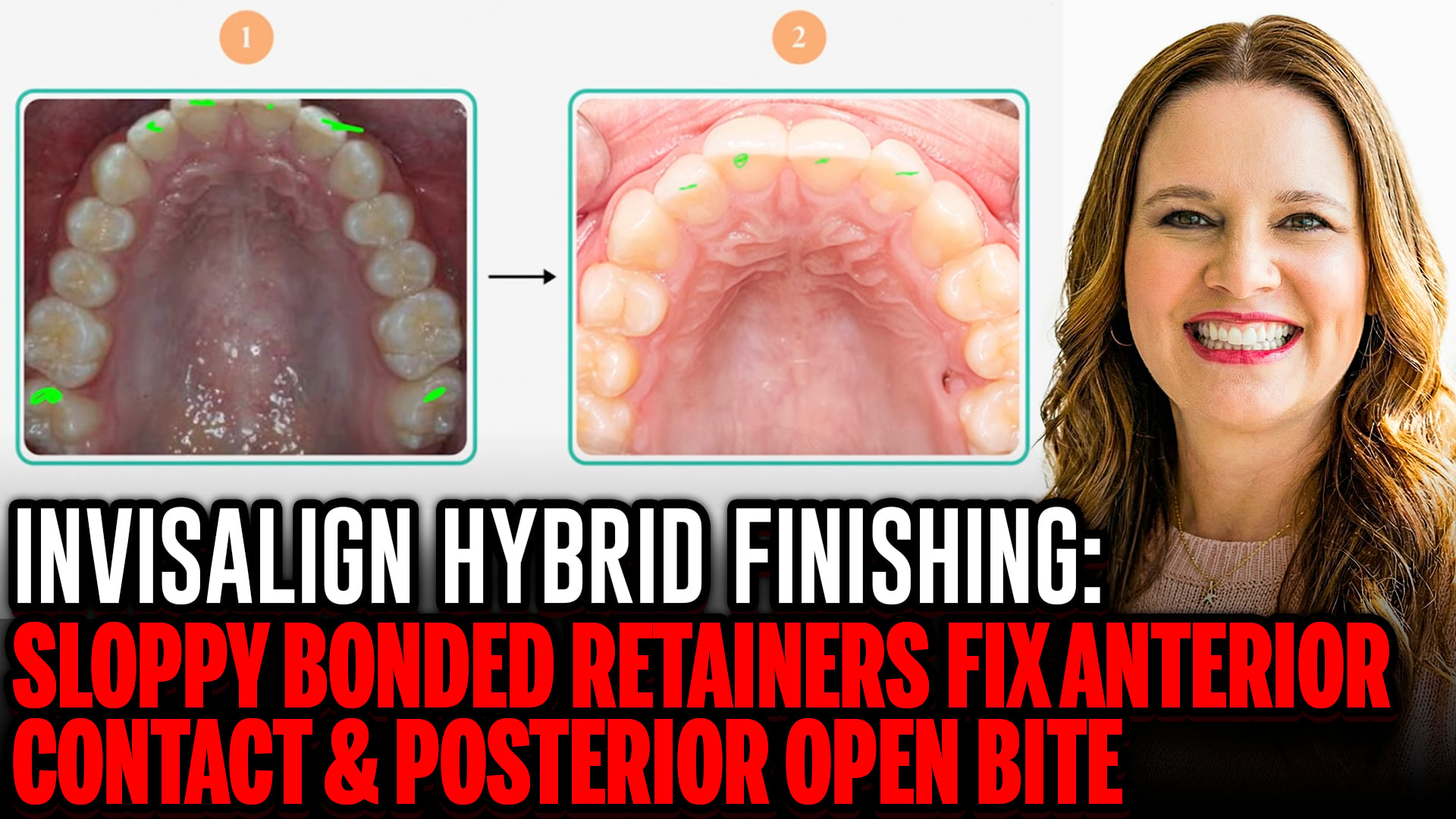
 Hybrid Secrets to Finishing Stubborn Invisalign and Clear Aligner Posterior Openbite Cases (POB)
I. Introduction
Dr. Amanda from StraightSmile Solutions addresses a common frustration: unbalanced contacts and POBs at the end of Invisalign or clear aligner treatment.
Finishing is the hardest part of orthodontics (Phase Three). Traditional braces allowed wire bends for magic; aligners require different strategies.
II. First Step: Use the Debond Workflow
Before anything, go through the step-by-step debond workflow (available to Dr. Amanda’s clients).
Make sure alignment, AP position, vertical, and transverse are all acceptable.
Identify exactly where you are stuck – often the order of finishing steps is wrong.
III. Single Arch Refinements
If one arch is good and the other is not, consider doing a single-arch refinement.
This prevents patient burnout and allows gravity/function to help settling.
Do NOT trap the opposite arch in an Essix – let it settle freely.
IV. Use Sloppy Bonded Retainers (In-Office)
If the upper arch is straight but lacking contacts, place a “sloppy bonded” retainer (braided wire + floss technique) on that arch.
This holds the front teeth straight while allowing posterior teeth to settle naturally.
An expensive lab-fabricated bonded retainer is unnecessary for temporary settling – save that for long-term retention.
V. Mini Deprogrammers and Free Settling
A mini deprogrammer (short aligner with heavy attachments, 3-3) can help with CR-CO shifts while working on the other arch.
It provides minor alignment but won’t produce extrusion or major movement.
In some cases (e.g., Phase 1-Phase 2 transition), doing nothing and letting teeth “free roam” settle is a valid option.
VI. The Bottom Line
Finishing stubborn POB cases often does not require endless refinements.
Hybrid techniques: single-arch refinements, sloppy bonded retainers, mini deprogrammers, or free settling.
Choose the method based on which arch is straight and where contact gaps exist.
These strategies save time, reduce patient frustration, and achieve balanced occlusion more predictably.