
Introduction
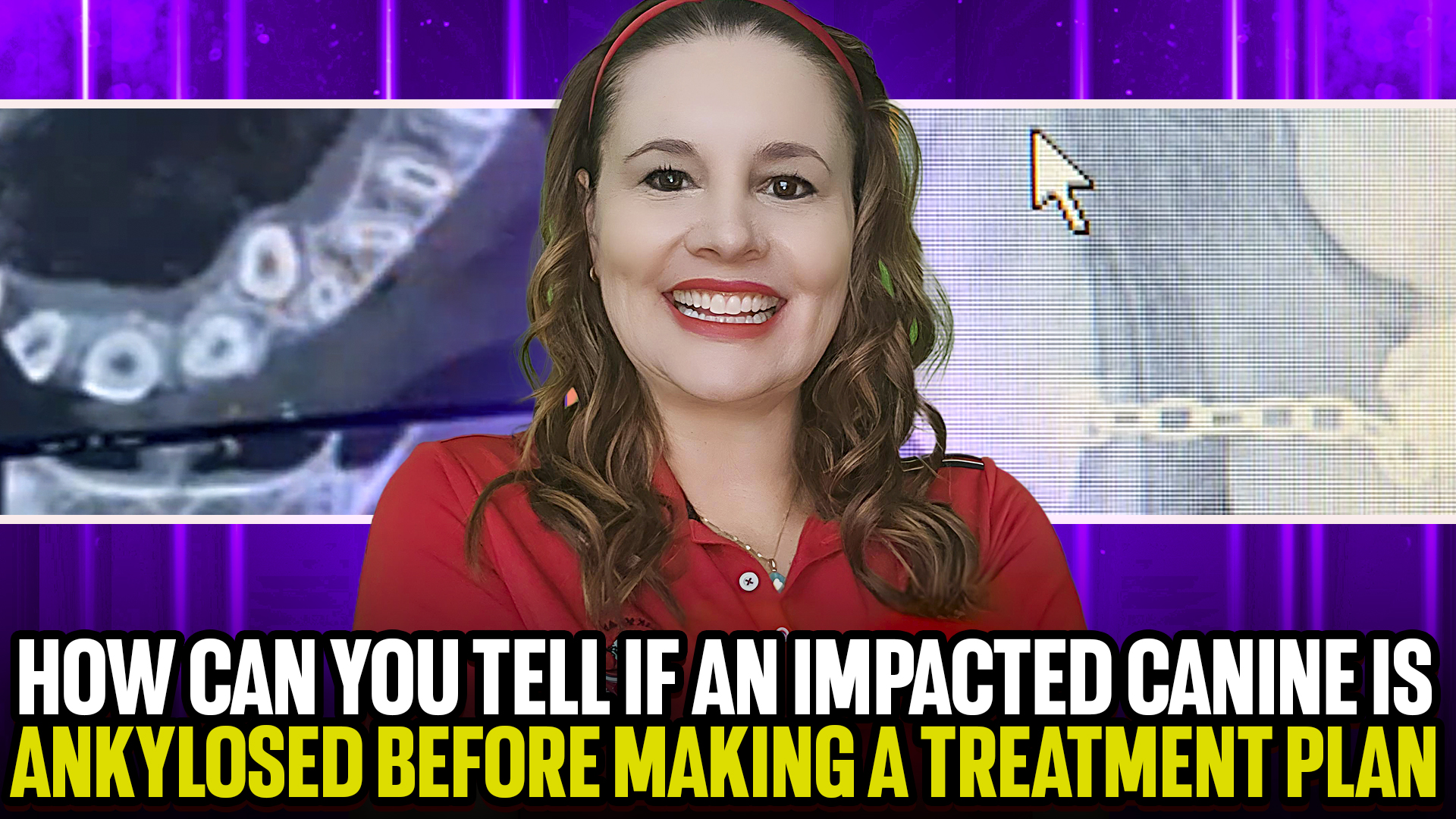
- Amanda addresses the challenge of identifying ankylosed or impacted canines before orthodontic treatment.
- Clarifies that Straight Smile Solutions doesn’t handle surgical cases but provides educational support.
- Emphasizes that recognizing ankylosis early prevents financial, ethical, and clinical issues for providers.
Ankylosis Definition & Causes
- Ankylosis = the root surface fuses to bone, losing periodontal ligament (PDL) flexibility.
- The tooth becomes “glued” in place, behaving like an implant.
- Often caused by trauma, abnormal root structure, or developmental issues.
Commonly Affected Teeth
- Most often: canines, premolars, and sometimes upper incisors.
- Rare in growing children but more likely in adults (20s–30s).
Diagnosis Tools & Methods
- CBCT (3D imaging): Best for full root visualization in 360°.
- 2D PA X-rays: Limited view; consider taking angled shifts for more perspective.
- True confirmation often comes only when traction is applied and the tooth fails to move.
Clinical Red Flags & Risk Factors
- Stalled tooth movement despite traction.
- Root resorption (external or internal).
- History of trauma, palatal crown position, tapered or oddly angled root.
- Mature, non-growing root apex (no apexogenesis).
Patient Communication & Documentation
- Always disclose ankylosis risk in informed consent forms.
- Get written acknowledgment if risk factors exist.
- Be realistic—prepare patients for the possibility that a tooth might not move.
Conclusion
- Ankylosis can’t always be predicted, but CBCT improves detection chances.
- Be cautious, particularly with adult or complex cases—if ankylosis occurs, the provider may bear financial responsibility.
- Amanda advises erring on the side of caution, managing expectations, and avoiding risky adult ankylosed cases when possible.