
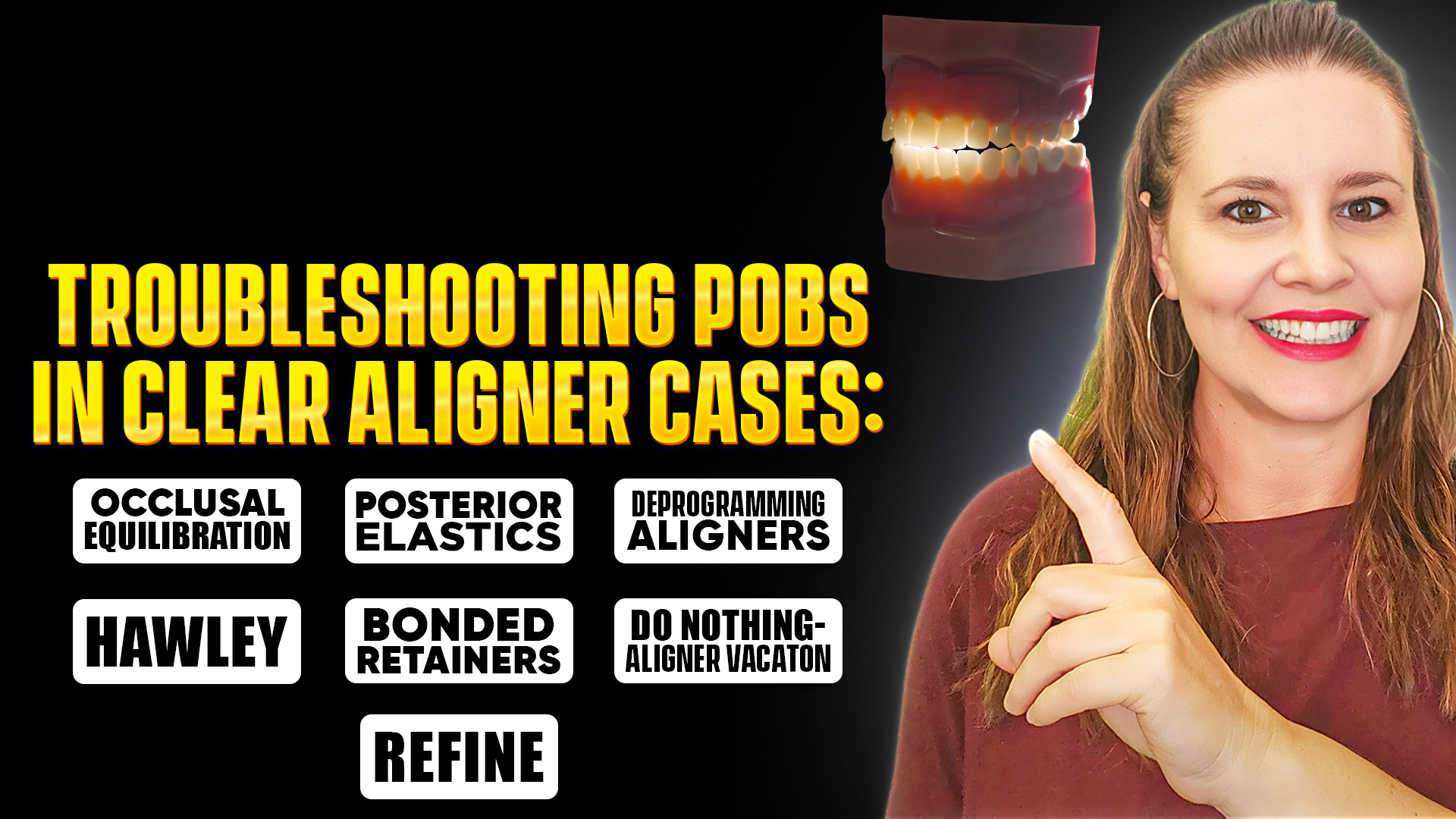
 How to Close a POB (Posterior Openbite) in Invisalign or Clear Aligners
Posterior open bites can be a challenging issue when using clear aligners. Many patients and practitioners struggle with finding the best approach to address this problem effectively.
This guide outlines the step-by-step process for diagnosing and treating posterior open bites in clear aligners:
Step 1: Identifying Premature Contacts
Before making any corrections, it is crucial to determine if premature contacts exist. Follow these steps:
● Use articulating paper instead of digital scans like iTero to check for premature contacts.
● Have the patient tap and grind their teeth to identify any high spots, especially on the anterior teeth.
● If contacts are found on teeth 7-8-9-10 or 22-26 (upper and lower anterior teeth), they must be addressed first.
Step 2: Correcting Anterior Premature Contacts
Once premature contacts are identified:
● If the interference is minor, occlusal equilibration may be sufficient.
● If the interference is more significant:
○ Perform interproximal reduction (IPR) on the lower anterior teeth if needed.
○ Ensure there is no crowding on the upper arch before proceeding with adjustments.
● Removing anterior premature contact ensures the bite can close properly in the posterior.
Step 3: Checking for Palatal Hanging Cusps
Another factor that can contribute to a posterior open bite is palatal impingement. Consider the following:
● If expansion is done without proper translation, hanging cusps may form.
● This issue is more common in older patients with less natural adaptation.
● The solution involves allowing more time for torquing and uprighting the teeth.
● If not addressed, palatal hanging cusps can interfere with posterior bite closure.
Step 4: Deprogramming Aligners
After eliminating anterior interferences, deprogramming aligners can help the bite settle. Methods include:
● Trimming the aligners to allow posterior contact to reestablish naturally.
● Using bonded retainers with or without elastics.
● Monitoring carefully to avoid overcorrection.
● Deprogramming allows teeth to settle into their natural occlusion without excessive force.
Step 5: Using Posterior Elastics (Last Resort)
Many practitioners rush to use posterior elastics, but these should be the last option after all other factors are addressed. Considerations include:
● Elastics can be used with buttons or bonded retainers.
● Patients must wear elastics full-time for effectiveness.
● Overcorrection is a risk, requiring close monitoring.
Step 6: Alternative Retention Methods
Apart from elastics, other effective methods include:
● Hawley Retainers (Hollies): These were widely used in the 90s and 2000s and can help settle the bite if designed without excessive clasps.
● Circumferential or Wrap-Around Hawley Retainers: These retainers avoid excessive posterior clasps and can be effective in maintaining bite closure.
● Bonded Retainers with Gravity: Sometimes, allowing gravity to work without elastics is a more gradual but effective method.
Step 7: Aligner Vacation (Do Nothing Approach)
In some cases, simply pausing aligner wear can allow the bite to settle naturally. Options include:
● Stopping aligner wear completely for a period.
● Wearing aligners only at night to observe any settling effect.
● This method mimics the passive effect of bonded retainers without the need for intervention.
Step 8: Refinement as a Last Option
If none of the above solutions work, refinement aligners may be necessary. Before opting for refinements:
● Ensure that all other premature contacts and interferences are corrected first.
● Only proceed if there is no alternative to closing the posterior open bite.
Conclusion
Correcting a posterior open bite in clear aligners requires a systematic approach. Careful diagnosis and step-by-step intervention will ensure a more stable and functional bite for the patient. For more expert advice, visit StraightSmile Solutions.