
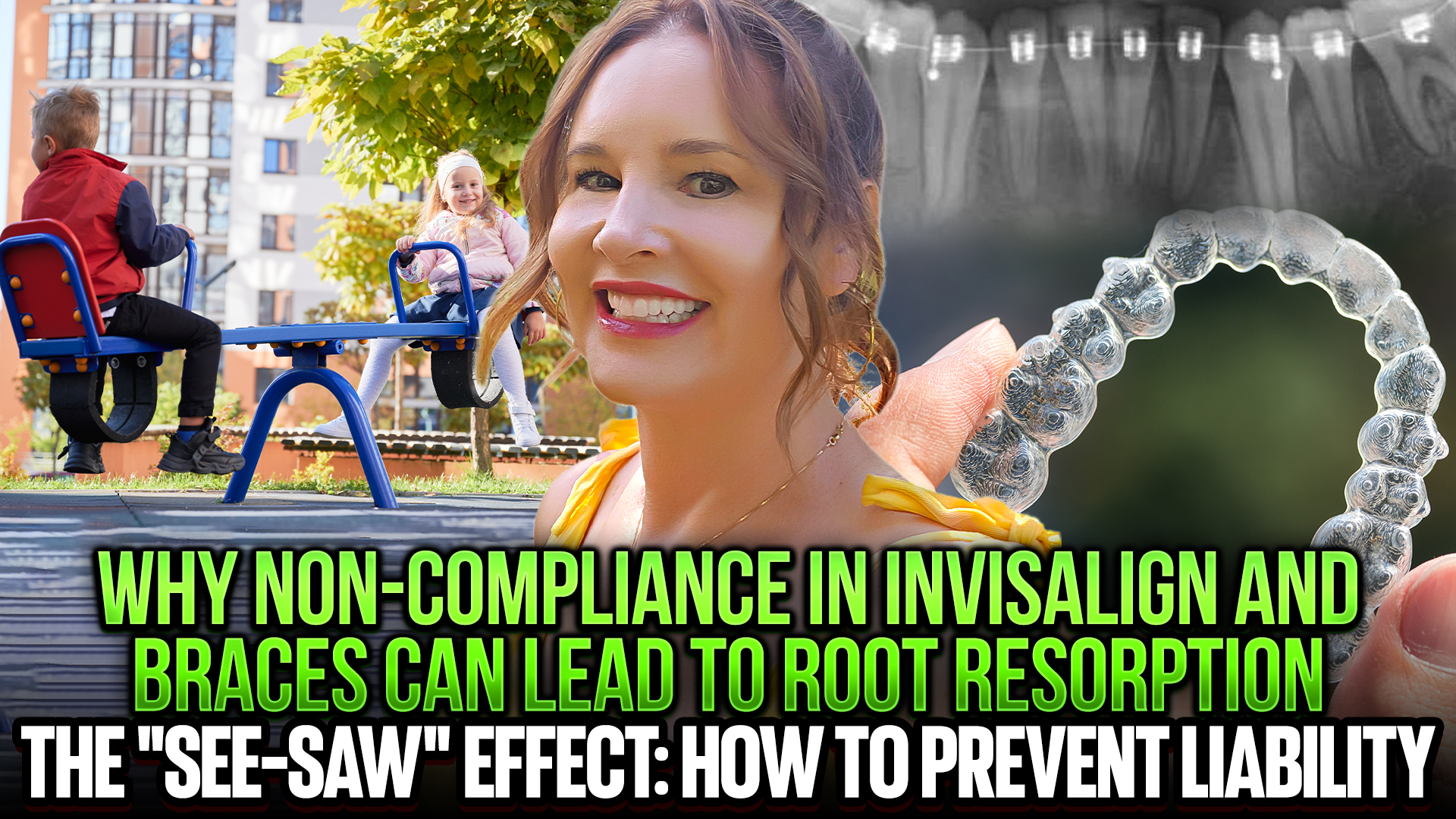
How Non-Compliance and Intermittent Wear of Aligners Can Cause the See-Saw Effect & Root Resorption
Introduction
Dr. Amanda introduces the concept of the “see-saw effect”, a term she coined to describe how intermittent or inconsistent wear of aligners (or other compliance-based orthodontic devices) can lead to damaging biological consequences, most notably, root resorption. She contrasts this with braces, which exert more controlled, consistent forces that don’t depend heavily on patient compliance.
- What Is the See-Saw Effect?
The “see-saw effect” occurs when forces on teeth fluctuate due to inconsistent appliance wear.- Example: A patient wears aligners only part-time. During wear, the teeth begin to move, but when the aligners are removed, the teeth relapse and experience opposing forces.
- This back-and-forth action leads to unstable pressure on periodontal ligaments (PDLs), stretching, compressing, and preventing proper bone remodeling.
- Over time, this instability results in root blunting, widened PDLs, and potentially permanent root damage.
- Why Aligners Are More Affected Than Braces
- Aligners rely entirely on patient compliance for consistent force application.
- Braces, on the other hand, provide continuous force even if the patient isn’t compliant except when elastics are involved, which are also compliance-based and can cause similar “see-saw” effects.
- Aligners with large step movements between trays can mimic this problem, increasing the risk of root resorption.
- Clinical Implications & Management
- Non-compliance should not be ignored. Continued treatment under intermittent wear can irreversibly damage roots.
- Progress X-rays and mobility checks should be routine for suspected non-compliance.
- If root damage or widening PDLs appear, treatment should be halted immediately, as switching to braces won’t fix the damage and may worsen it.
- For persistent non-compliance, clinicians may need to end treatment and offer a partial refund, depending on contractual terms.
Conclusion
Dr. Amanda stresses that orthodontic success requires steady, continuous forces. When patients don’t comply, the resulting on-and-off pressure creates a “see-saw effect” that destabilizes teeth and can cause permanent root damage. Clinicians need to monitor progress carefully, set clear expectations with patients upfront, and be willing to stop treatment when compliance fails.