
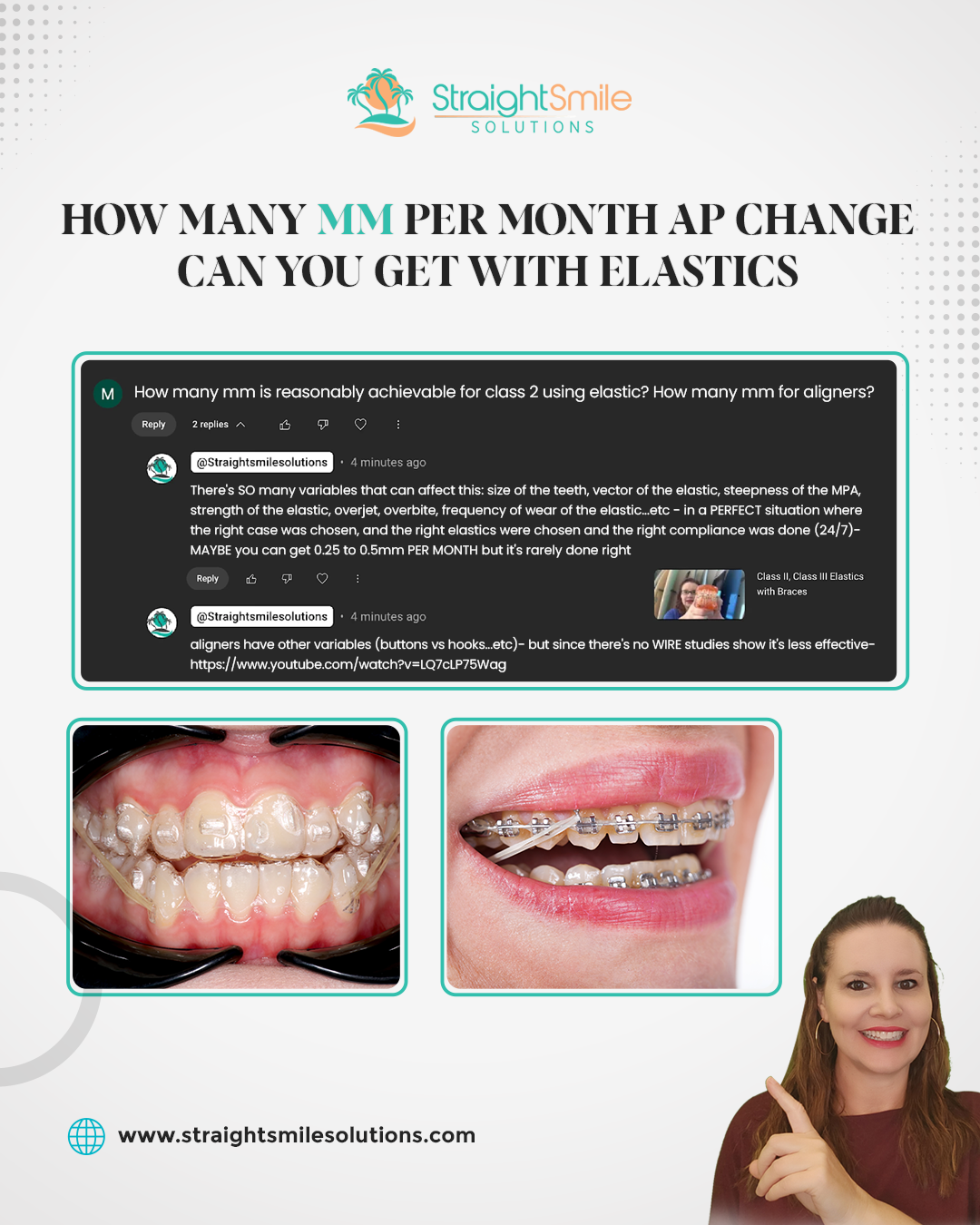
 How Much Movement in MM per Month for Class II and Class III Elastics
Introduction
• Dr. Amanda from Straight Smile Solutions addresses a common orthodontic question: How many millimeters of correction can be expected per month with Class II or Class III elastics in braces or aligners?
• She emphasizes that this is a difficult question to answer precisely because of the many variables influencing outcomes.
Why It’s Hard to Measure
• A reliable scientific study on elastic movement is nearly impossible due to variables such as:
o Elastic strength, size, and diameter.
o Vector and direction of pull.
o Patient compliance (hours worn, removal during meals, etc.).
o Tooth size, mandibular plane angle, and amount of overjet/overbite.
• Compliance is the biggest unknown; until technology exists to measure actual wear, results will remain unpredictable.
General Estimates
• Most orthodontists would estimate 0.25–0.5 mm per month of AP change with proper elastic wear.
• Important reminder: elastics cause dental tipping and occlusal plane changes, not skeletal growth.
• Class II elastics: aim to reduce overjet by pulling the lower jaw forward.
• Class III elastics: aim to correct negative overjet by encouraging backward correction.
Braces vs. Aligners
• Braces: elastics attach to wires anchored across multiple teeth → generally more effective.
• Aligners: elastics attach to teeth or aligner wings → may cause aligner displacement and tracking issues.
• Common prescriptions:
o Braces → 3/16” heavy elastics.
o Aligners → 3/16” medium elastics.
• Clinicians must test multiple sizes to find the best fit for each patient.
Additional Factors
• Latex elastics perform better than non-latex due to less force decay.
• Growth-phase patients wearing elastics showed no negative jaw rotation effects.
• Clinicians should be cautious about “false correction” from patients subconsciously sliding their jaws forward in the chair to simulate improvement.
Conclusion
• No exact MM-per-month rule exists for Class II or Class III elastics because outcomes depend on compliance, appliance type, and patient biology.
• A rough average is 0.25 – 0.5 mm per month under ideal conditions, but results vary widely.
• Orthodontists should monitor every 4 weeks, verify stability by reducing wear to nights only, and remain realistic that many improvements are positional shifts, not permanent skeletal changes.