
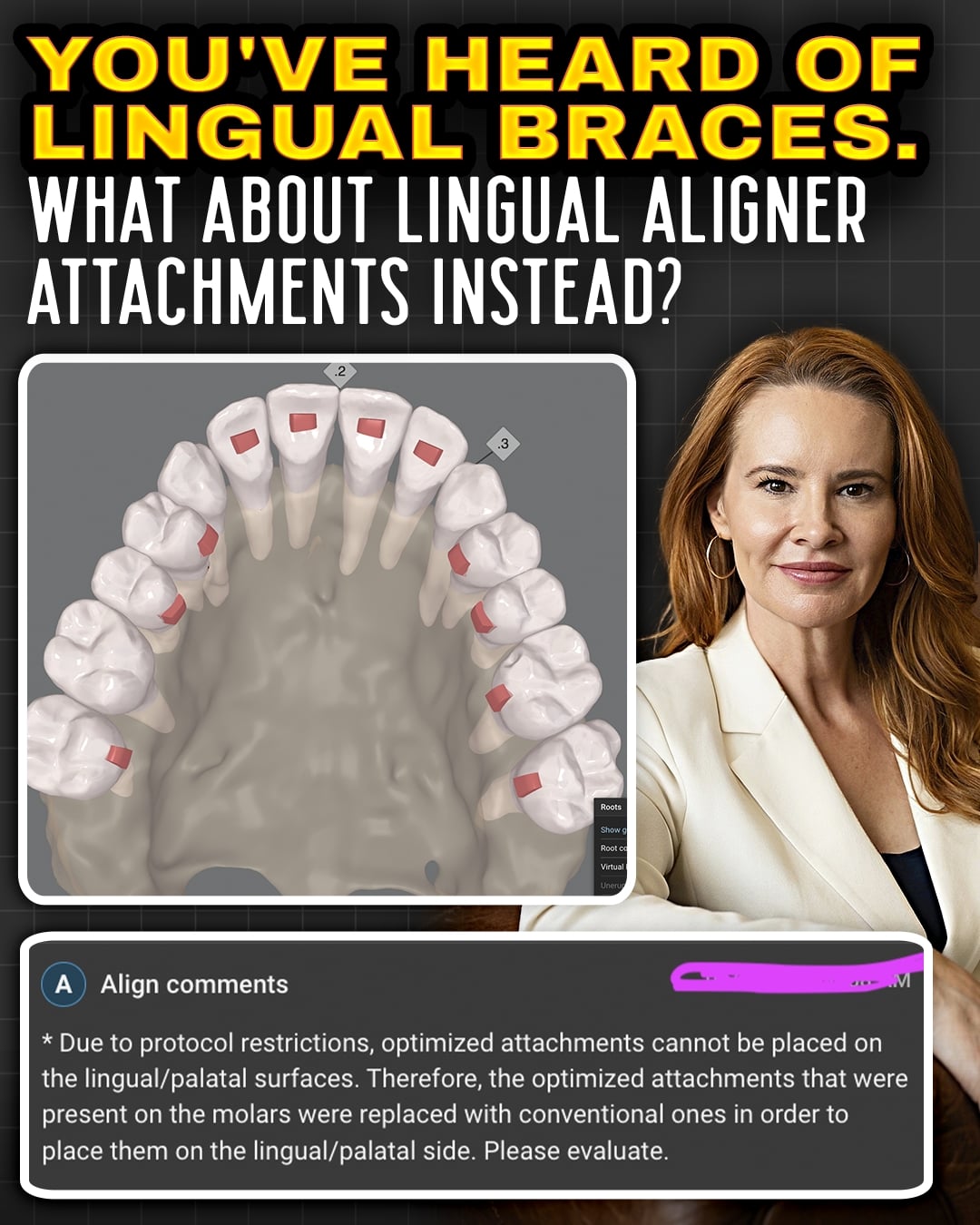
 Hidden Precision: How Inside-the-Tooth Attachments Keep Invisalign Truly InvisibleStandard Invisalign treatments rely on tooth-colored composite bumps placed on the front surface of the teeth to guide movement. However, advanced digital customization allows providers to request traditional attachments placed strictly on the lingual and palatal surfaces instead. This technique completely eliminates the visible exterior bumps, offering an entirely invisible alternative for highly aesthetic or concierge-level patient demands.While highly discreet, inside-the-tooth positioning requires careful clinical execution. The shape and anatomy of the back of the teeth differ significantly from the front, meaning standard automated software defaults cannot be used. Doctors must manually override the aligner software and design the plan step-by-step. This process requires more clinical time, hands-on planning, and four-handed chairside dentistry to successfully bond the composite materials.Because of the specialized techniques required, lingual attachments work best when restricted to the upper arch to avoid the extreme bonding difficulties commonly found on lower teeth. Patients may experience slight initial bite interference, similar to standard anterior bite turbos used in traditional orthodontics. To prevent knocking the attachments loose and to keep tooth-moving forces completely consistent, patients are often encouraged to keep their aligners in place while eating, followed immediately by strict brushing and flossing routines.For modern dental practices, offering interior attachments serves as an excellent boutique marketing tool. Instead of a standardized, cookie-cutter approach, providers can offer this highly customized aesthetic experience under a premium, specialized billing model. By thinking outside the box, dentists can cater directly to patients seeking premium discretion throughout their smile journey.