
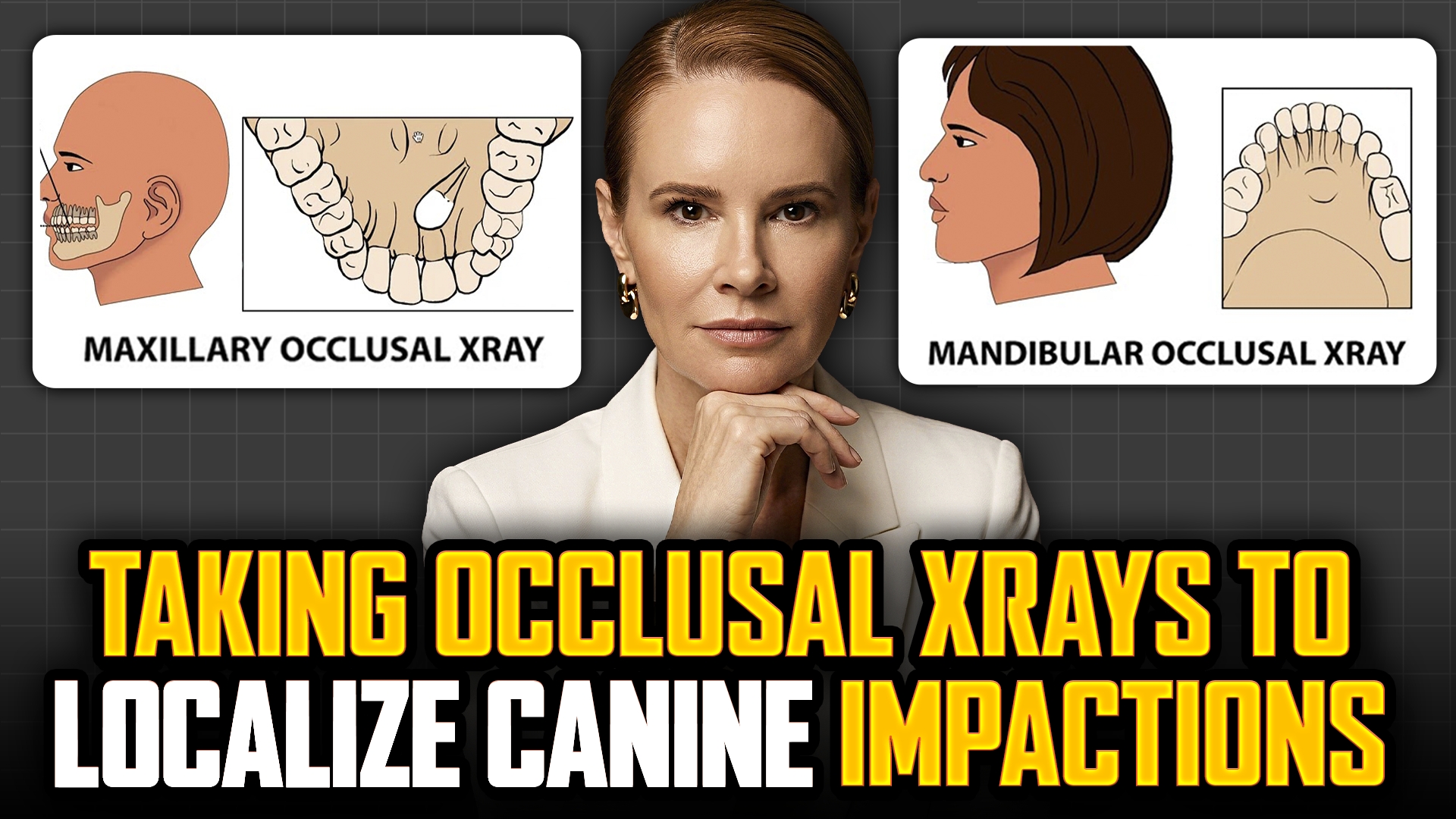
In modern dentistry, Cone Beam Computed Tomography (CBCT) has become a popular standard for 3D imaging. However, not every general or pediatric practice has a CBCT machine on-site. Furthermore, many clinicians prefer to minimize radiation exposure for their youngest patients whenever possible. Fortunately, you do not need expensive 3D imaging to accurately locate palatal or lingual canine impactions. You can achieve excellent diagnostic clarity by going back to basics with traditional occlusal X-rays.
Beyond the SLOB Rule
Most dentists remember the “Same Lingual, Opposite Buccal” (SLOB) rule from dental school. While it is a reliable conceptual tool, capturing a clean, direct occlusal view is often much easier and more efficient. A single, well-placed occlusal film provides a definitive look at the dental arch, allowing you to instantly visualize exactly where an impacted tooth sits. Beyond canines, this highly versatile technique helps locate salivary stones, tori, supernumerary teeth, and abnormal roots.
Master the Angulation
Achieving a perfect occlusal radiograph requires precise positioning. The patient should bite down gently on a standard 2.25 by 3-inch film inserted lengthwise. Make sure they do not bite too hard, as heavy pressure creates unwanted indentations on the image.
- For Maxillary Views: Position the X-ray cone at a steep 60 to 65-degree downward angle relative to the patient’s occlusal plane.
- For Mandibular Views: Have the patient lie completely flat and position the cone directly beneath the jaw, shooting upward.
If your office runs out of dedicated occlusal film, you can replicate this technique using a standard periapical (PA) film. Just keep the exact same angulations in mind, though you must accept a smaller field of view that risks cutting off crucial structural landmarks.
Screening Early for Smart Referrals
Identifying canine position early—ideally around ages six to eight—fundamentally changes your treatment planning. Generally, buccal or labial impactions are much easier to manage mechanically. If your occlusal X-ray reveals a severe palatal impaction, it serves as an immediate signal. For general practitioners just starting out in orthodontics, palatal cases are notoriously difficult and are best referred to an experienced specialist early on.