
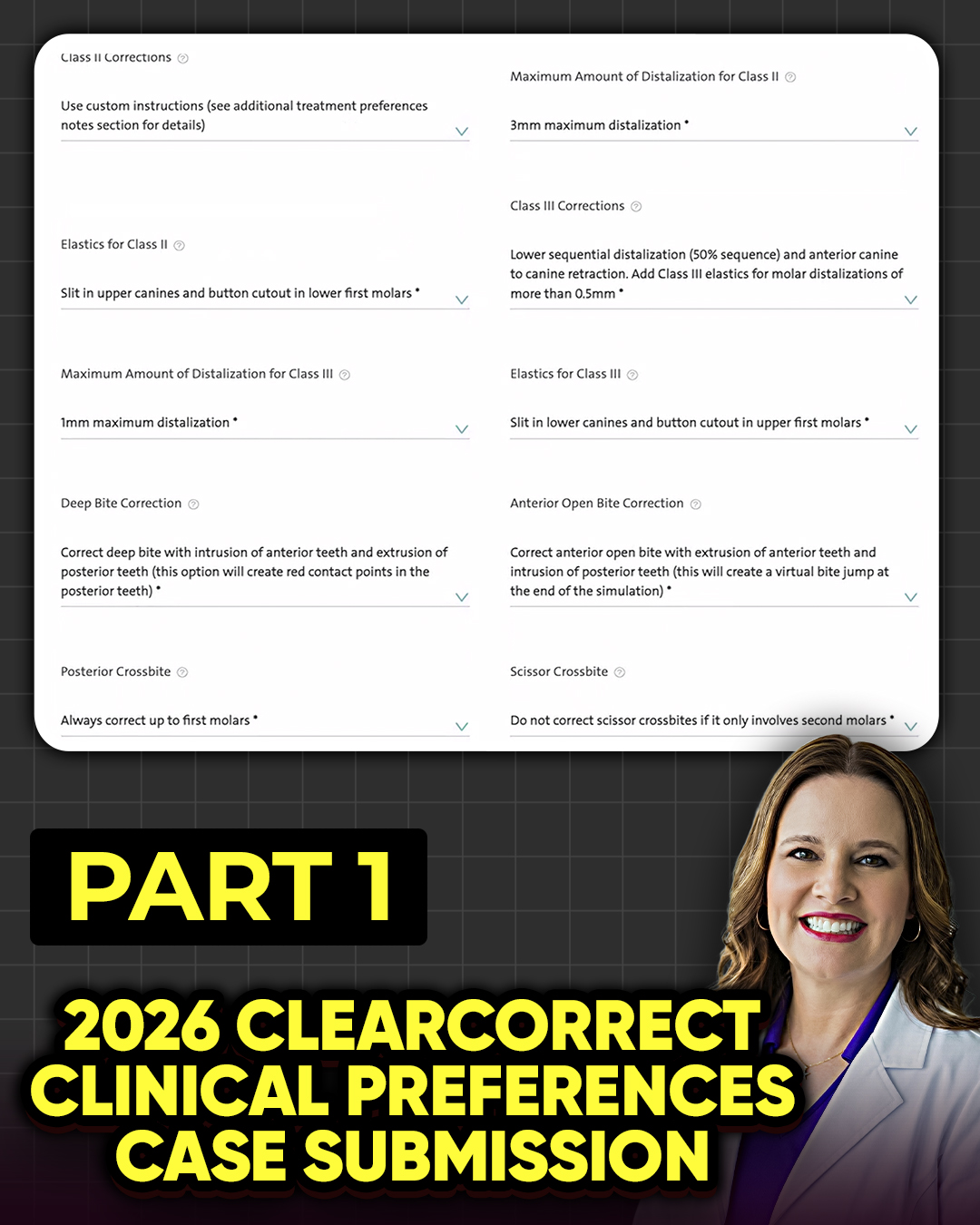
 Getting Real with Class II Cases: How to Plan for Success with ClearCorrectWelcome to part one of our 2026 ClearCorrect clinical preferences case submission series! Today, we are breaking down Class II cases and how to fix them. A Class II case usually means a small lower jaw or a large upper jaw, where protruding upper teeth create an overjet.Before jumping in, always take a supplementary X-ray to confirm the specific Class II type. Then, cross-reference this with the patient’s facial anatomy and E-line to ensure your clinical findings match.Next, perform an airway and myofunctional screening. You must evaluate if fixing the overjet is functionally healthy, or if it will make things worse. For instance, if a patient has a large tongue and small mouth volume, shrinking that space further through extractions, IPR, or sequential distalization is a bad idea. If you are unsure how to diagnose this, call on an ENT or an oral myofunctional therapist (OMT) for help.Once you know you can safely proceed, look at your treatment options. Your path depends on whether the patient is mandibular deficient or maxillary protrusive. If you are fixing the upper arch, you can use IPR, sequential distalization (if third molars are absent), or Class II elastics—though elastics are not always highly effective. Extracting bicuspids is another option.However, if you need to stimulate lower jaw growth, ClearCorrect cannot do that alone. Skeletal growth only works if the patient is still young and growing. For these cases, you will need to use Invisalign with Mandibular Advancement (MA) or an auxiliary appliance first, then use ClearCorrect to finish. If you are treating a fully grown adult, those growth options are off the table. Stay tuned for Part 2!