
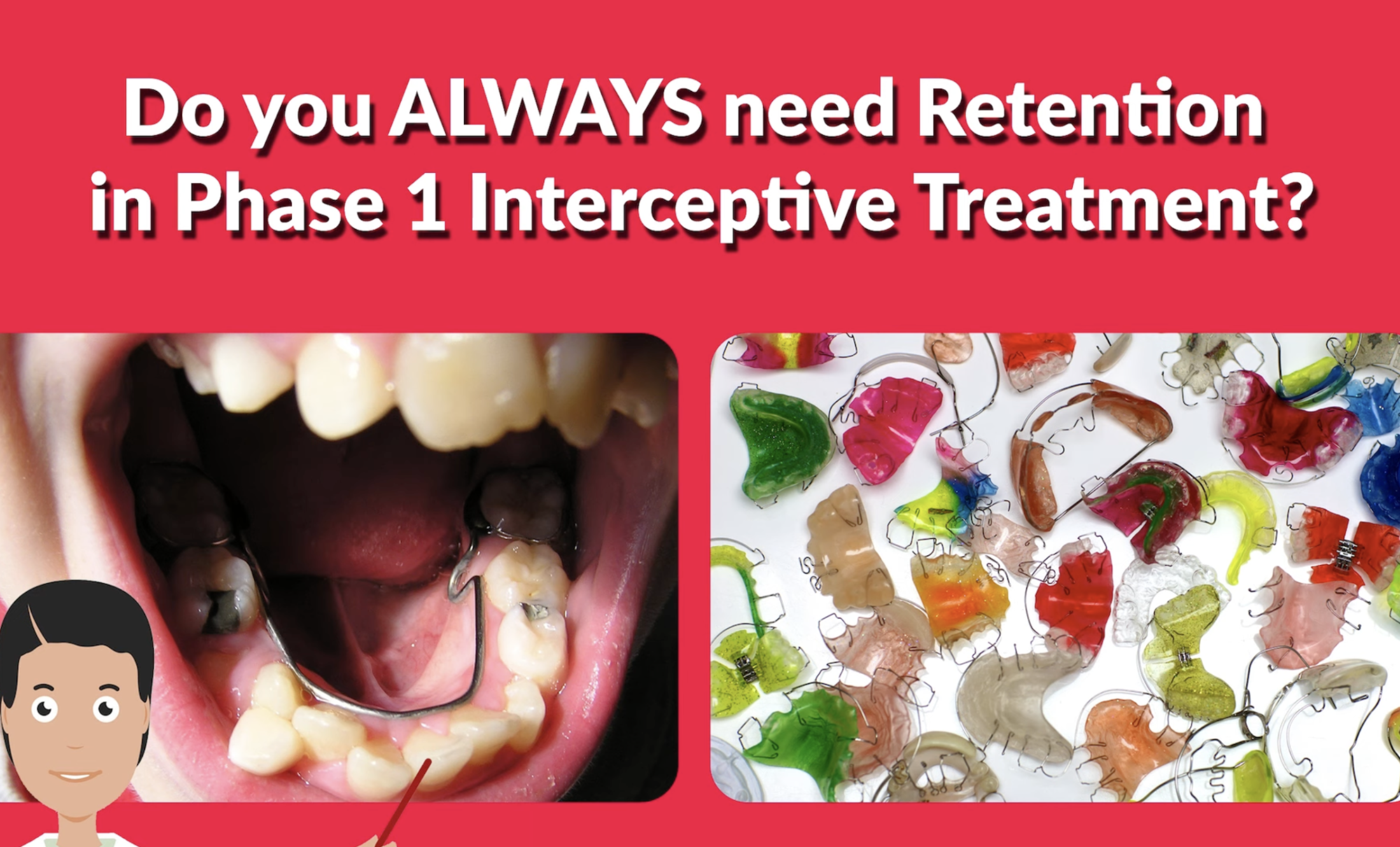
Do you ALWAYS need retention for Phase 1 Interceptive Treatment?
The age-old question of whether retainers are necessary after Phase 1 orthodontic treatment remains a topic of debate among orthodontists. The answer is not straightforward and depends on various factors, such as the patient’s initial condition, the treatment undertaken, and the patient’s preferences.
Understanding the Complexity
A foundational understanding of Phase 1 interceptive treatment is essential to grasp this topic’s details. Prior knowledge from an extensive 13-hour course on this subject is recommended, which can be accessed through YouTube or a newly launched organized course on the website Straight smile solutions.
Options and Considerations
Different treatment scenarios yield varying stability outcomes:
● Transverse correction: When Phase 1 addresses transverse issues like bite problems, maintaining the corrected position for the recommended 3 to 6 months is typically stable. A transpalatal arch (TPA) can help ensure transverse stability.
● Vertical correction: For deep bite corrections, maintaining the correction for 4 to 6 months is generally stable, with slight relapse. Customized retainers can help counter this minor relapse.
● Lower jaw growth correction: Corrections involving lower jaw growth tend to be stable, often with minimal relapse. Over-correction strategies can be employed to counter any potential relapse.
● Aligning teeth: Aligning teeth can lead to relapse due to the memory of periodontal ligaments. Therefore, some form of retention, such as retainers or other options, is usually necessary for a stable outcome.
Retention Options and Education
The Phase 1 course comprehensively covers various retention options, including bonding retainers, Thoreau retainers, and lower lingual arches. Choosing the appropriate retention method depends on the specific treatment and the patient’s expectations.
Upcoming CE Course
An upcoming Continuing Education (CE) course is set to be launched by CE Zoom, providing an in-depth exploration of Phase 1 treatment. The course will be available with and without case assistance and will be certified for CE credit, catering to diverse state CE requirements. This course offers a more concise understanding of the topic and benefits practitioners seeking to enhance their knowledge.
Personalized Approach
The necessity for retainers post-Phase 1 varies depending on the treatment and the patient’s needs. If the patient is committed to Phase 2 and accepts minor aesthetic relapse, retainers may be optional. However, personalized retainer options, such as bonding retainers or other solutions, can be discussed for patients prioritizing minimal relapse.
Conclusion
Whether retainers are required after Phase 1 orthodontic treatment is contingent on the specifics of the treatment conducted, patient preferences, and expected outcomes. While some corrections are stable without retention, aligning teeth and certain corrective measures necessitate a tailored retention plan. Considering the initial condition, treatment strategies, and patient expectations, an informed approach is essential for optimal post-Phase 1 care.