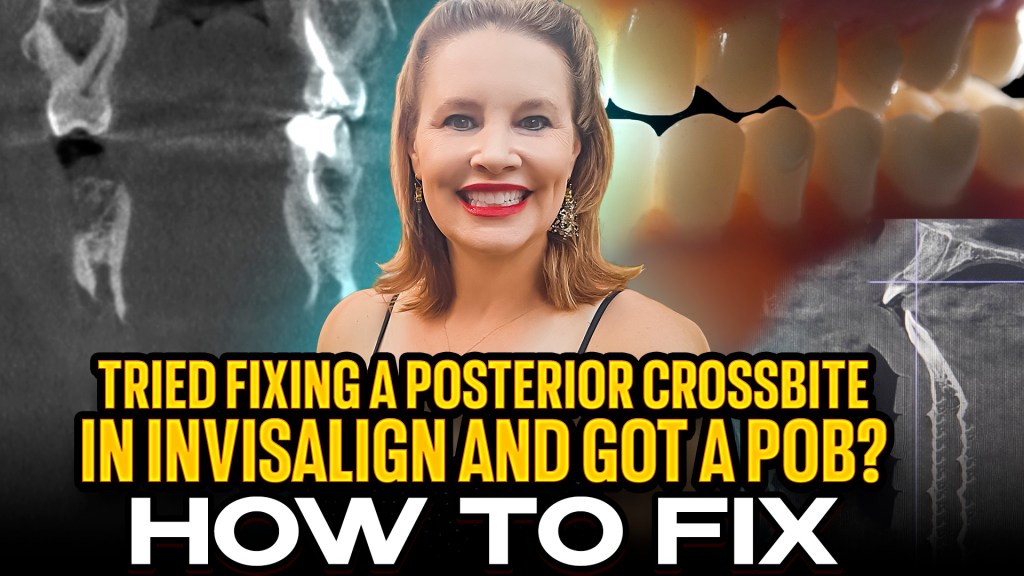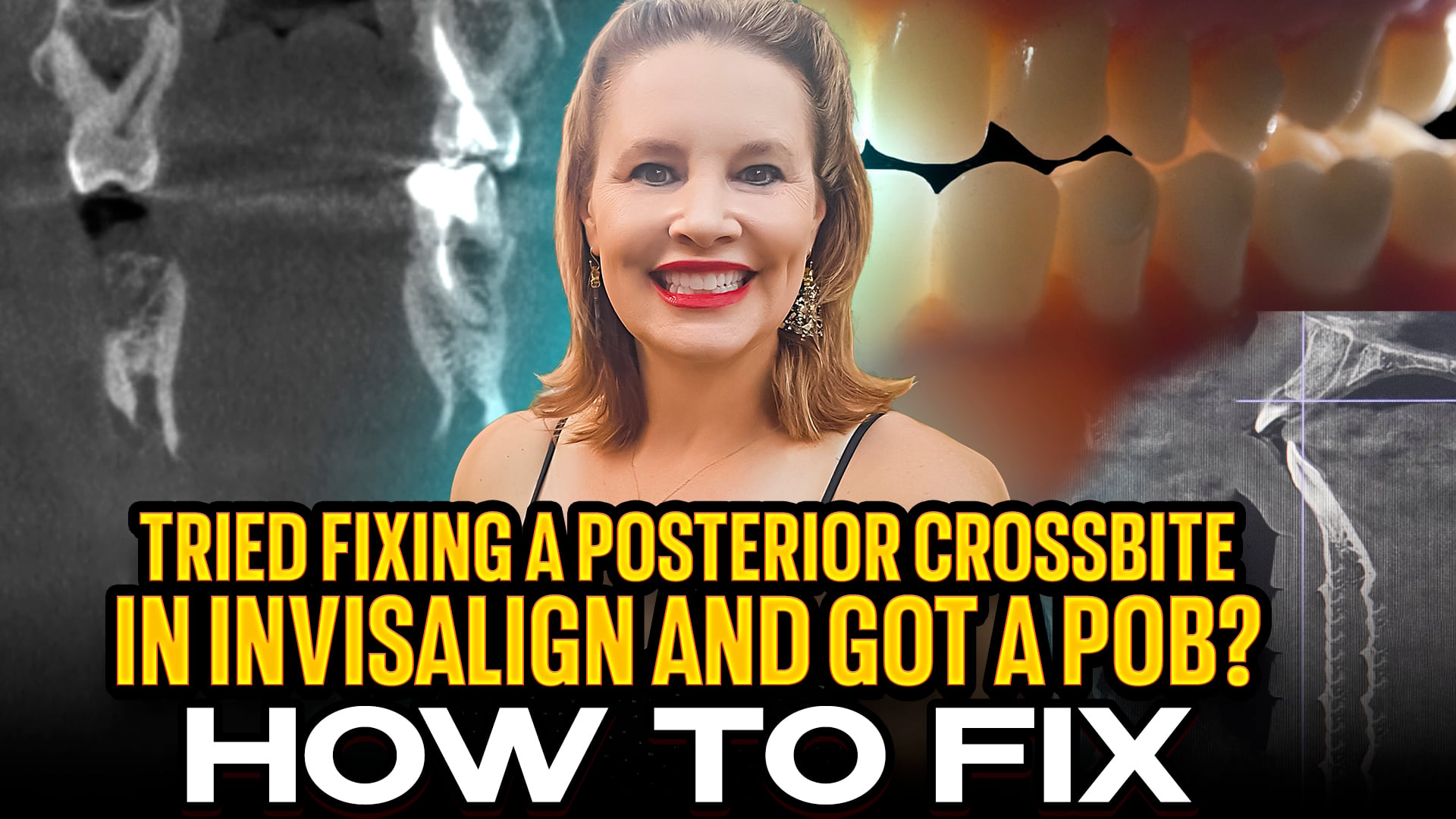
- Introduction to Posterior Open Bites (POBs) and Crossbites
• Dr. Amanda from Straight Smile Solutions revisits the topic of posterior open bites (POBs) and posterior crossbites—common challenges in aligner orthodontics.
• POB = Posterior Open Bite; can be caused by vertical issues or arch expansion interferences.
• Emphasis on identifying the true cause—whether it’s vertical (bite opening due to intrusion/eruption) or transverse (due to arch shape or bone limitations).
• Aligners often fail to address these issues unless the underlying skeletal/bone anatomy is carefully considered.
• Planning errors (e.g., over-expanding or misdiagnosing the curve of Wilson) lead to complications that aligners alone cannot fix. - Diagnostic Tools: CBCT & Curve of Wilson Evaluation
• CBCT imaging is invaluable for planning, especially in adults, where bone stability is more predictable.
• CBCT-integration features (available in Invisalign and Spark) offer high-value insight, but not all platforms (e.g., Clear Correct) support it.
• Even if CBCT isn’t integrated, clinicians should examine transverse slices to evaluate bone presence and the Curve of Wilson shape.
• The Curve of Wilson (buccal-lingual inclination of molars) must be upright for proper occlusion—distortion leads to POBs.
• AI in aligner portals isn’t yet reliable for predicting bone response—manual assessment is essential.
III. Expansion Pitfalls and Treatment Planning
• Over-expansion is a common recommendation in ortho courses, but it’s not always safe.
• If the bone isn’t there, expanding the arch can push teeth out of the bony housing, creating instability and bite issues.
• Dr. Amanda warns that elastics or trimming trays cannot fix POBs caused by transverse interferences like an exaggerated curve of Wilson.
• Determining if the problem is skeletal vs. mechanical is the first step to effective planning.
• Clinicians must ask: “Can I expand?” “Is there bone?” “What’s happening with the Curve of Wilson?”
- Assessing Incisor Position & Bone Housing
• Flared incisors may already be outside the bony housing—further movement worsens the situation.
• Instead of flaring more, retraction might offer better stability and esthetics.
• CBCT or cephalometric images help confirm tooth position in relation to the alveolar bone.
• Important for making decisions about IPR, extractions, or avoiding over-expansion.
• Dr. Amanda emphasizes time-saving diagnosis: seasoned orthodontists can visually assess flared incisors without waiting for metrics.
- Conclusion and Clinical Takeaways
• Crossbites and POBs must be diagnosed correctly—vertical vs. transverse root causes.
• Use CBCT and assess the Curve of Wilson to avoid treatment failures.
• Aligners alone cannot fix biomechanical problems caused by poor planning or bone limitations.
• Utilize available tools and imaging to customize treatment, especially for complex cases.
• With accurate diagnostics and conservative biomechanics, clinicians can treat tougher cases safely and successfully.