
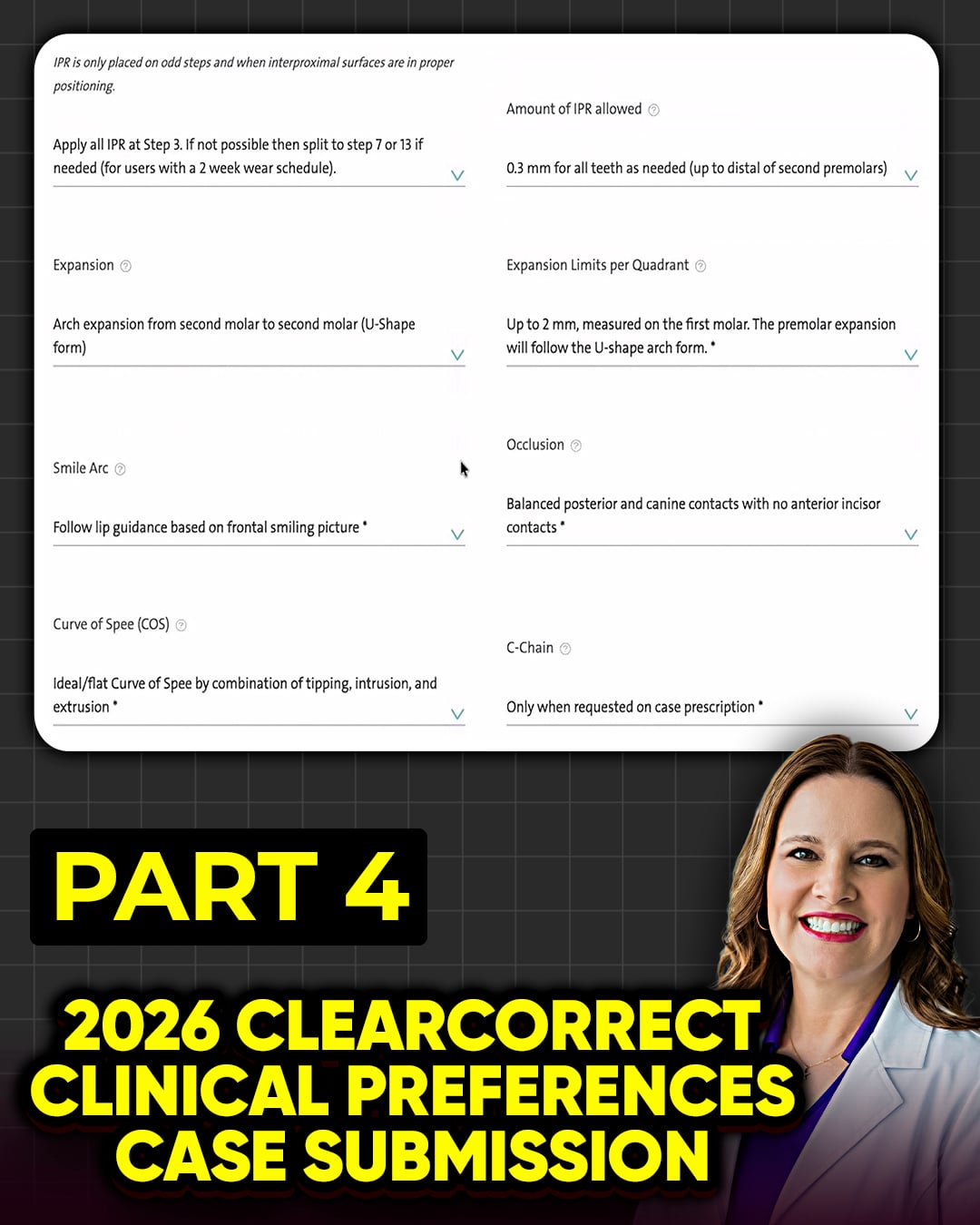
Predictable clear aligner outcomes rely heavily on a stable foundation. When configuring your ClearCorrect clinical preferences, how you handle occlusion, the curve of Spee, and virtual C-chains will determine your ultimate clinical success.
The Golden Rule of Balanced Occlusion
Never start a case that does not already have a balanced posterior occlusion. If a patient presents with a wonky or unstable bite, treat it as an immediate red flag. This irregularity could signal a condylar shift, joint degradation, a myofunctional issue, or even an underlying airway problem. Avoid taking on cases filled with “maybes” and “ifs.”
Your goal is to finish with even, balanced posterior contacts on all opposing teeth, while maintaining zero anterior contacts. This approach represents the standard of care unless you are deliberately prepping the case for subsequent restorative work.
Managing Curve of Spee and Virtual C-Chains
ClearCorrect asks for your default preference on the curve of Spee, but this is highly case-dependent and relies heavily on the patient’s unique facial morphology. Because there is no one-size-fits-all solution, select the system default for your submission profile and customize it during the 3D setup review.
Similarly, approach the virtual C-chain feature with extreme caution. Do not apply it universally to all your case preferences. While it can be useful for closing residual spacing, it can easily derail a case if you do not fully understand its mechanics. I have published extensive content regarding how C-chains operate—originally popularized by Invisalign—on my YouTube channel. Check out those videos to ensure you are using this tool safely.