
Bracket Repositioning: How Straight Smile Solutions Can Help
In some cases, you might find that your patients need their brackets repositioned, and knowing how to go about this isn’t always easy. After all, there are several ways you can look at bracket repositioning, and knowing the difference is vital. Luckily, as your professional orthodontics consultancy team, we here at Straight Smile Solutions can help.
Tackling Bracket Repositioning in Orthodontics
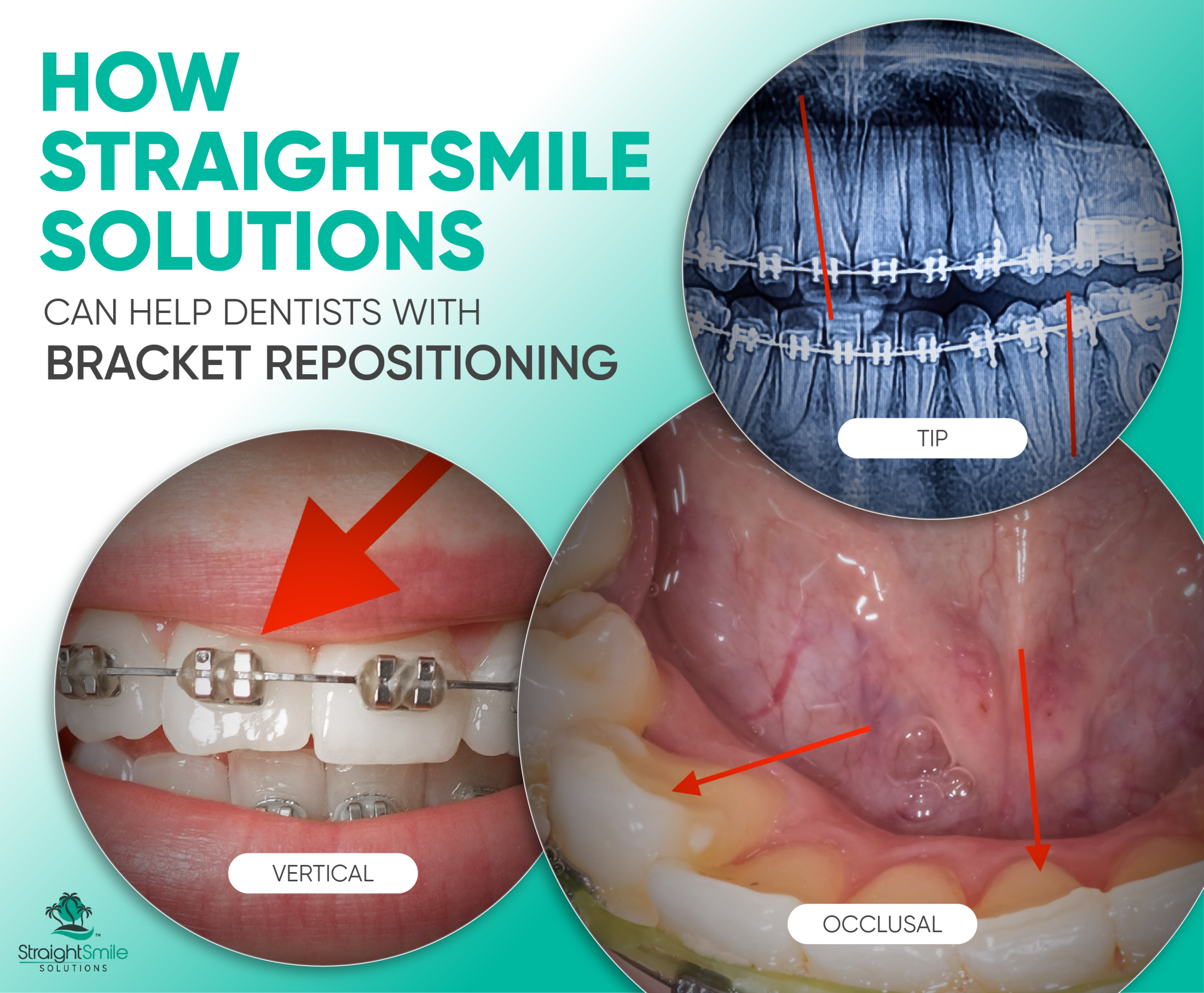
There are three main ways you can approach bracket repositioning cases: tip, vertical, and occlusal views. You’ll need to first take a progress x-ray, which allows you to look at the root positioning; ideally, you want to make sure these are all parallel. Always consider that distortions are possible, so check any potential problems clinically.
When checking vertical cases, you need to consider factors such as gum line and the bite, as well as symmetry (especially in the upper 2s or 7 and 10).
Meanwhile, for occlusal cases, you’ll need to consider the upper and lower arches (taking a photo at 90 degrees to the occlusal plane helps significantly) and the current positioning of the teeth to see whether repositioning or rotation are needed.
Of course, if you are trying to reposition on a very minor case, this may not make a significant amount of difference in the final results (and could have aesthetic implications for the patient). As such, you may want to leave and monitor these cases, depending on the patient’s preference. However, more significant cases with root positioning issues will need to be addressed as soon as possible.
All of these factors are important to keep in mind when considering bracket repositioning; however, since this can be a lot to think about and consider (and getting the bracket repositioning wrong can have significant consequences for the progress of a treatment plan), our experts here at Straight Smile Solutions can help. Indeed, as orthodontics experts, we can help you determine the most accurate approach for your own cases.