
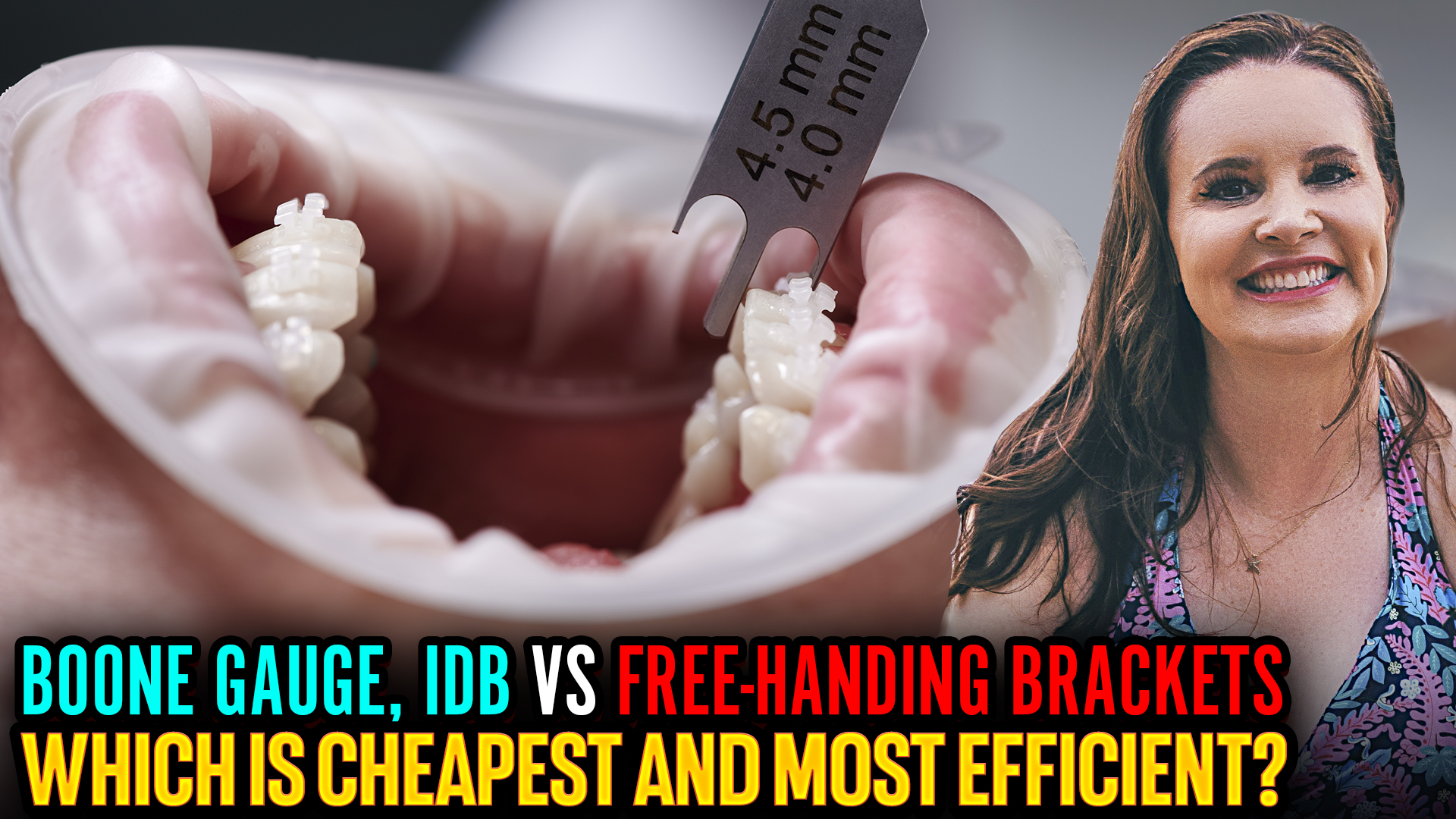
 Boone Gauge, IDB vs Free-Handing Brackets – Which Is Cheapest and Most Efficient?
I. Introduction
Dr Amanda from StraightSmile Solutions compares indirect bonding (IDB) with free-handing brackets.
Her strong recommendation: general dentists should use IDB for accuracy and predictability.
But bracket breakages happen, so you still need to know how to freehand when necessary.
II. Why Indirect Bonding Wins
Free handing requires years of experience to develop a good “eyeball” for bracket placement.
Most beginners place many brackets incorrectly, learning only through mistakes.
IDB lets you see the final setup digitally, tweak positions, and bond with confidence.
Affordable IDB options are available from multiple vendors.
III. The Problem with Boone-Type Gauges
Some doctors think a mechanical gauge makes free handing accurate.
Dr Amanda has seen many cases done entirely with such instruments – she was not impressed.
Teeth vary in size, shape, wear, and angulation. A one-size-fits-all gauge cannot account for individual anatomy.
It only works for “run-of-the-mill generic teeth,” which most patients don’t have.
IV. How to Free-Hand When You Must
Use a recent pano on the computer screen in front of you.
Work one quadrant or one arch at a time.
Mirror brackets: 8 and 9 should match, 7 and 10 should match, etc.
Draw the long axis of each tooth on the pano (as taught in residency).
Place brackets at the center of the clinical crown, but adjust based on your treatment plan (e.g., intrude a worn tooth).
Use a perio probe to check parallelism and symmetry.
V. Fixing Mistakes
After initial levelling with a light wire (e.g., 16 NiTi), errors become visible.
Brackets can be removed and repositioned as needed.
VI. Cost and Efficiency
IDB is not expensive and saves chair time by reducing repositioning.
Free handing is “cheapest” upfront but costs more in time, frustration, and compromised results.
For a busy practice, IDB is far more efficient and predictable.
VII. The Bottom Line
Use indirect bonding for initial placement; it’s accurate, affordable, and efficient.
Learn to free-hand for emergencies (broken brackets) using a pano and careful mirroring.
Skip the Boone gauge. It won’t give you the results you want.