Boone Gauge, IDB vs Free-Handing Brackets – Which Is Cheapest and Most Efficient?
I. Introduction
- Dr Amanda from StraightSmile Solutions compares indirect bonding (IDB) with free-handing brackets.
- Her strong recommendation: general dentists should use IDB for accuracy and predictability.
- But bracket breakages happen, so you still need to know how to freehand when necessary.
II. Why Indirect Bonding Wins
- Free handing requires years of experience to develop a good “eyeball” for bracket placement.
- Most beginners place many brackets incorrectly, learning only through mistakes.
- IDB lets you see the final setup digitally, tweak positions, and bond with confidence.
- Affordable IDB options are available from multiple vendors.
III. The Problem with Boone-Type Gauges
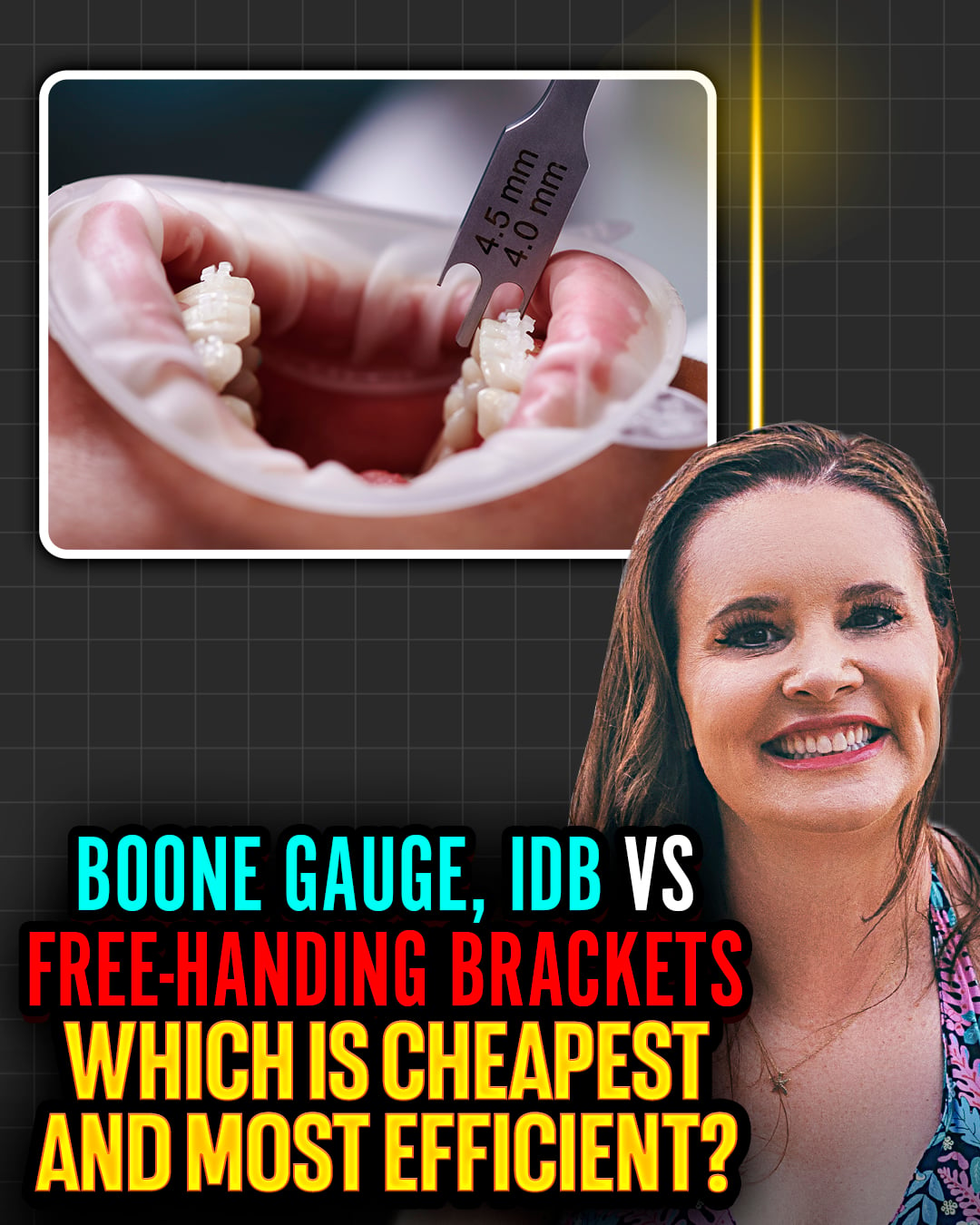
- Some doctors think a mechanical gauge makes free handing accurate.
- Dr Amanda has seen many cases done entirely with such instruments – she was not impressed.
- Teeth vary in size, shape, wear, and angulation. A one-size-fits-all gauge cannot account for individual anatomy.
- It only works for “run-of-the-mill generic teeth,” which most patients don’t have.
IV. How to Free-Hand When You Must
- Use a recent pano on the computer screen in front of you.
- Work one quadrant or one arch at a time.
- Mirror brackets: 8 and 9 should match, 7 and 10 should match, etc.
- Draw the long axis of each tooth on the pano (as taught in residency).
- Place brackets at the center of the clinical crown, but adjust based on your treatment plan (e.g., intrude a worn tooth).
- Use a perio probe to check parallelism and symmetry.
V. Fixing Mistakes
- After initial levelling with a light wire (e.g., 16 NiTi), errors become visible.
- Brackets can be removed and repositioned as needed.
VI. Cost and Efficiency
- IDB is not expensive and saves chair time by reducing repositioning.
- Free handing is “cheapest” upfront but costs more in time, frustration, and compromised results.
- For a busy practice, IDB is far more efficient and predictable.
VII. The Bottom Line
- Use indirect bonding for initial placement; it’s accurate, affordable, and efficient.
- Learn to free-hand for emergencies (broken brackets) using a pano and careful mirroring.
- Skip the Boone gauge. It won’t give you the results you want.