Introduction
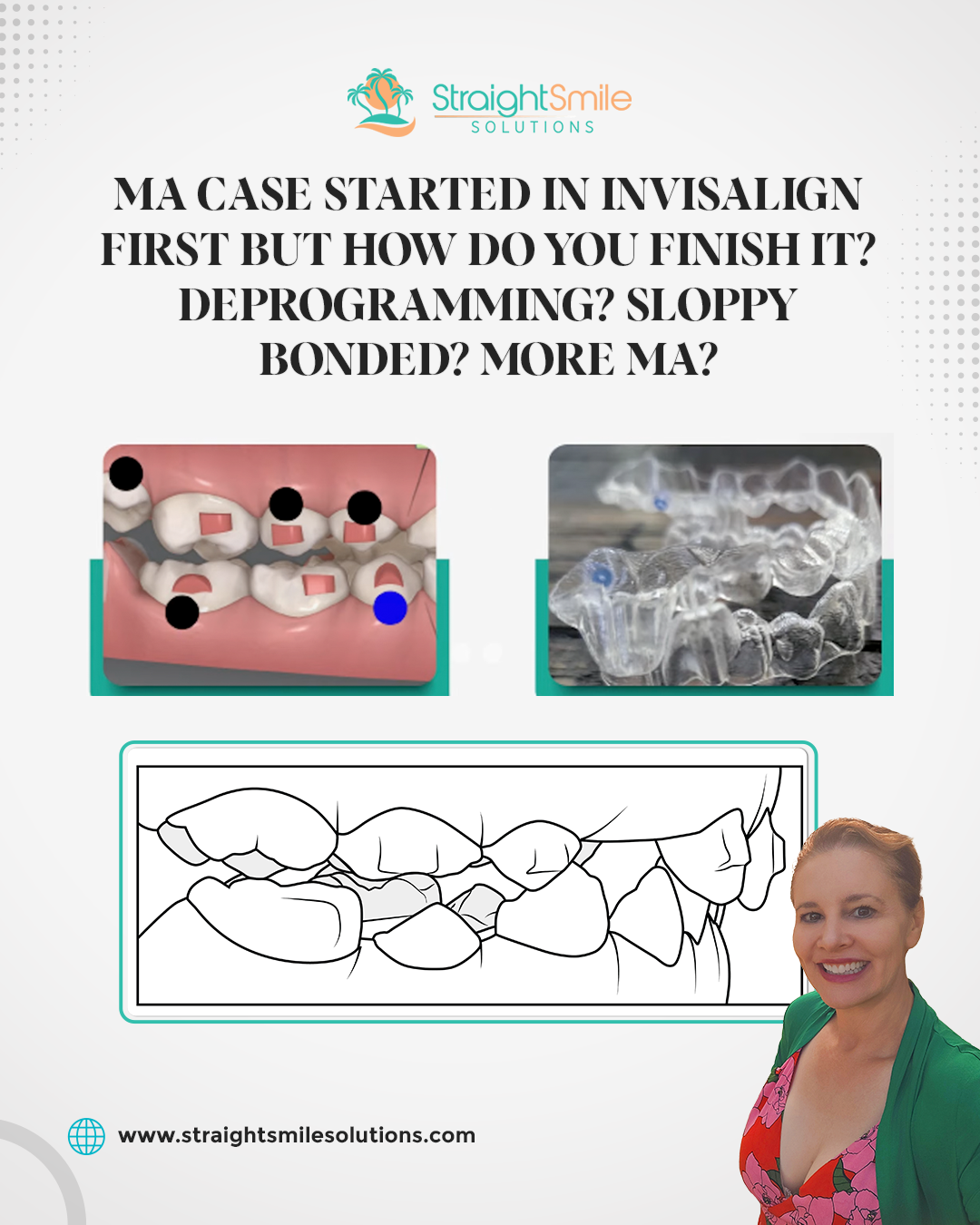
Dr. Amanda reviews why posterior open bites (POBs) are expected and normal after mandibular advancement (MA) with Invisalign. A strong POB is often a positive sign of patient compliance and a successful MA phase. Because POBs vary widely, choosing the right finishing method requires careful, case-specific thinking.
- Why POBs Occur After MA
- POBs are not complications; they are built-in consequences of how MA shifts the jaw and loads forces.
• Severity varies due to anatomy, jaw angulation, bite force, eating habits, wear time, and whether patients chew with aligners in.
• “Full POBs” where all posterior teeth are open are easiest to correct.
• “Messy POBs” with uneven or mixed contacts are more challenging and require thoughtful decision-making.
- Common Options to Resolve MA-Related POBs
- AI-generated orthodontic suggestions highlight standard possibilities:
– Elastics
– Aligner modifications
– Refinement with new attachments
– Bonded retainers
• Dr. Amanda notes these answers are not wrong but oversimplified; MA-related POBs behave differently than standard Invisalign POBs.
• Invisalign’s own teaching recommends a “do nothing” transition (TBTG), though many clinicians find it unreliable.
- Dr. Amanda’s Practical Approach
- Three preferred options:
- Do Nothing – allow natural settling; often the safest and best during busy seasons.
- Sloppy Bonded Retainers – can help settle the bite but break easily, especially around holidays.
- Mini-Aligner Refinements – possible but risky; can overcorrect without strict virtual monitoring.
• Every MA case is a puzzle requiring individualized reasoning based on patient behavior, parent expectations, and office logistics.
• Consider seasonal timing: during holidays, avoid bonded retainers or treatments requiring high accountability tracking.
Conclusion
POBs after MA are predictable, manageable, and often indicators of successful treatment. There is no single best method; instead, clinicians must tailor the finishing approach to the level of compliance, timing, and oversight capacity. When in doubt, especially during busy periods, doing nothing and allowing natural bite settling is often the safest and most reliable strategy.