
Introduction
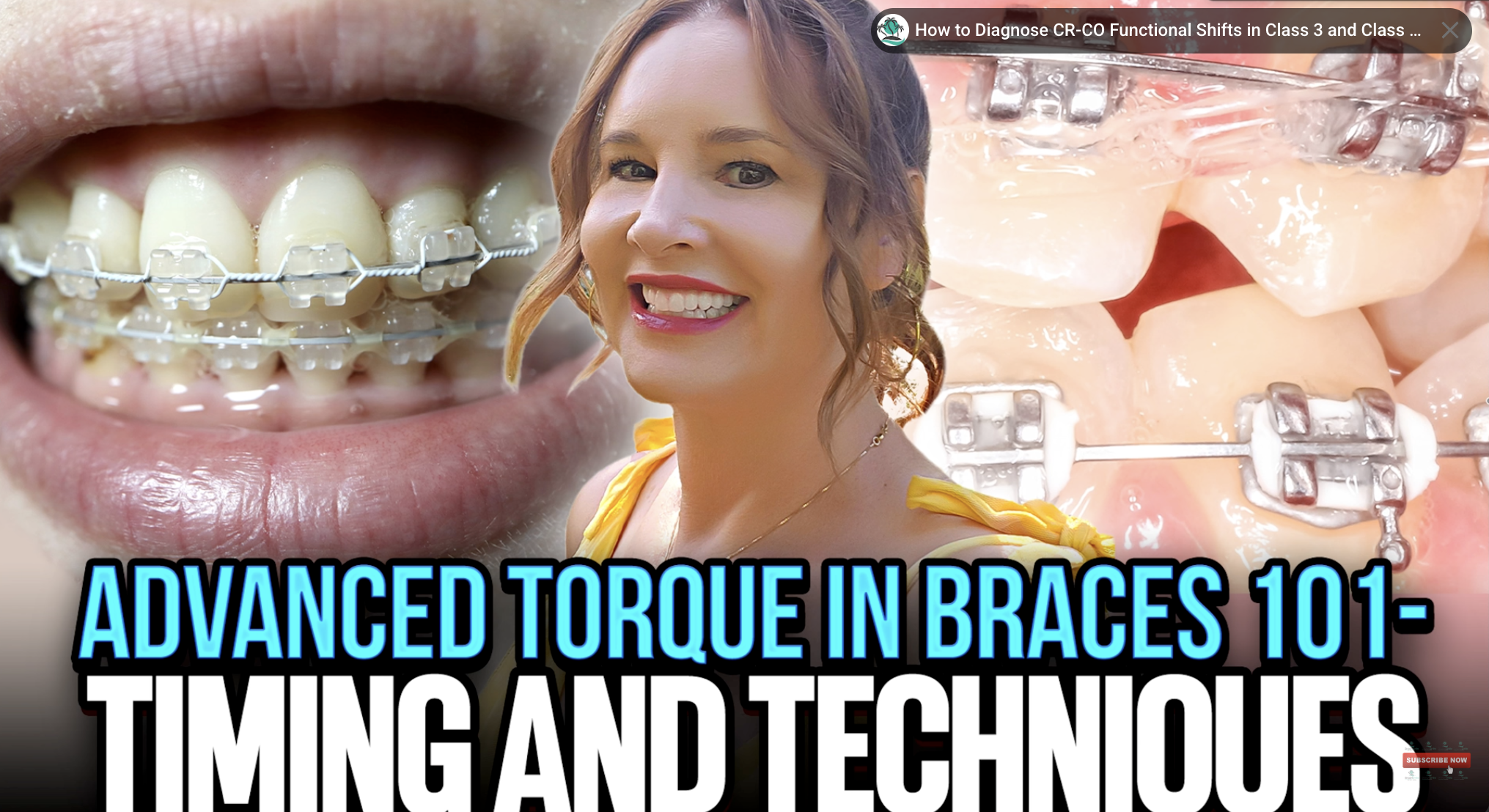
Dr. Amanda explains the fundamentals of achieving proper torque in orthodontic cases. Emphasizes that special wires, pliers, or brackets are rarely necessary if treatment planning and wire sequencing are done correctly. Torque cases are slow movements, typically taking 24–36 months to complete.
- Understanding Torque
- Key distinctions: palatal/root torque vs. labial/root torque; front teeth vs. back teeth terminology (buccal vs. lingual).
• Positive vs. negative torque must be understood for each tooth type; incorrect labeling can confuse.
• Most patients do not care about perfect torque, so extreme measures are often unnecessary.
• Examples: uprighting lateral incisors requires palatal root torque, while others may need labial root torque.
- Timing and Wire Sequence
- Proper torque is achieved only after the slot has been filled and teeth have expressed.
• Wire sequence must be followed in the correct order; skipping steps can result in poor outcomes.
• Torque movement is gradual; spaces may form during active torque, but can be closed later.
• Using smaller bracket slots (e.g., 18 vs. 22) allows faster slot filling with less force, reducing the risk of root resorption.
- Options for Extra Torque
- Optional tools include:
– Torquing pliers
– Special brackets with built-in torque
– pre-torqued wires
• Dr. Amanda rarely uses these options; proper technique and patience usually suffice.
• Heavy initial torque or improper wire engagement can hinder progress and cause poor results.
Conclusion
Correct torque depends primarily on treatment planning, proper wire sequencing, and patience, rather than specialized tools. Extreme torque tools are optional, not required. Most cases can achieve satisfactory outcomes without the need for special wires, brackets, or pliers, thereby keeping treatment simpler, safer, and more predictable.