
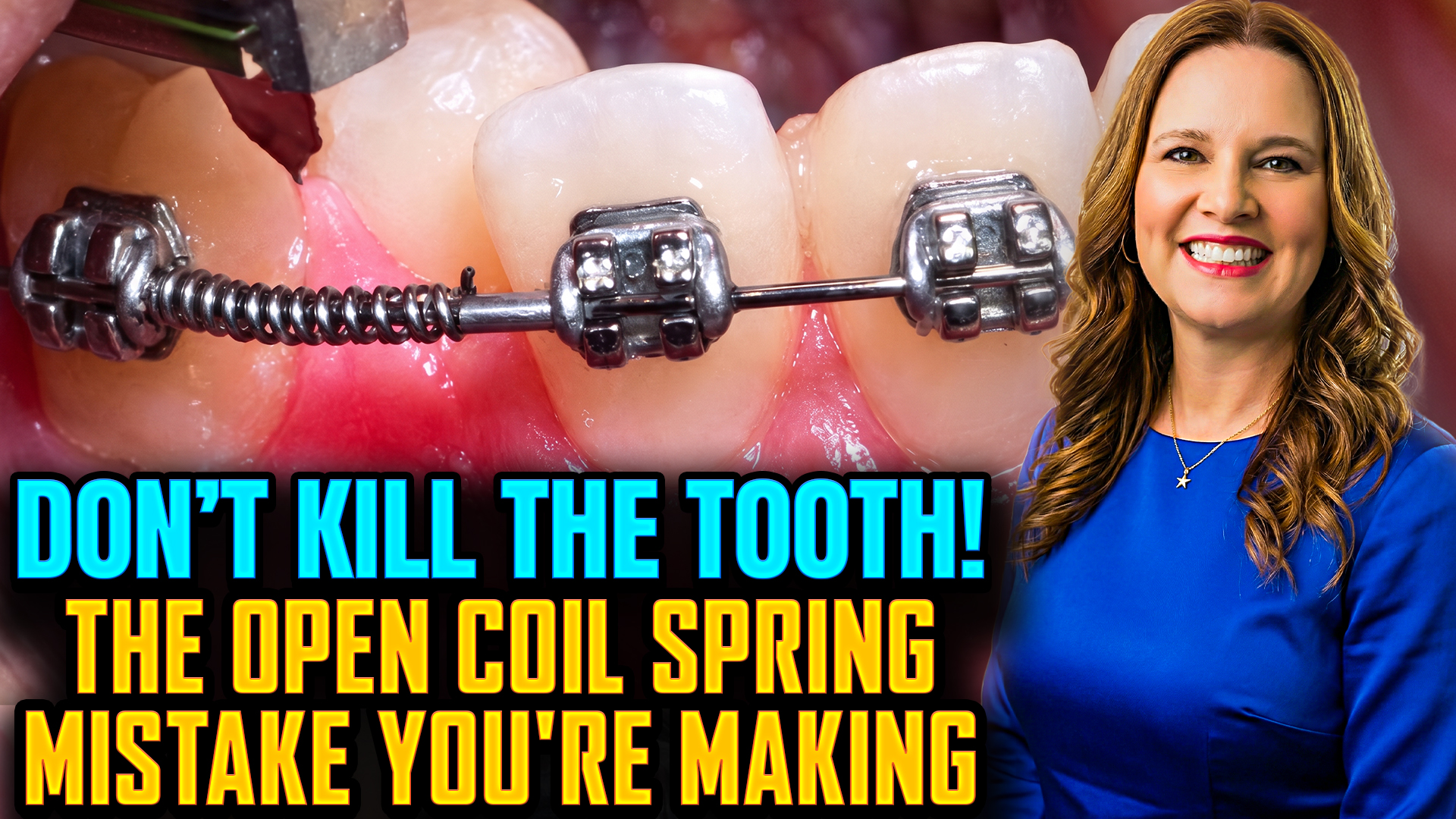
 Open coil springs are fantastic orthodontic tools for gaining space or uprighting molars, but using them incorrectly can easily derail your treatment plan. One of the most common mistakes general and pediatric dentists make is rushing to place an open coil spring on the wrong type or size of archwire. If you place a spring on a wire that is too light, you risk completely losing control of the teeth.
The first rule of thumb is material choice. You should always select nickel-titanium (NiTi) open coil springs rather than stainless steel. NiTi possesses a shape memory that delivers a gentle, continuous force, which works infinitely better for space creation.
The second rule is all about filling the bracket slot. Many standard orthodontic courses show pictures of springs on light, round wires, but in practice, this creates a major issue called “slop.” If you place a spring on a light round wire inside a standard 0.022 bracket slot, the force will cause the adjacent teeth to rotate radically, often flaring mesial out. Left unmonitored, this excessive, uncontrolled force can push teeth right through the buccal plate, causing fenestration, periodontal issues, and even pulp devitalization.
To prevent this, you must be patient and wait until you are on a heavy rectangular wire that fills the slot. For a 0.022 bracket slot, your absolute minimum wire should be an 18×25 or a 19×25. If your practice uses a 0.018 bracket slot, the smallest wire you should use is a 17×25. Fully filling the bracket slot guarantees the necessary torque and stability to handle the spring’s force safely, keeping your treatment predictable and your patients safe.