
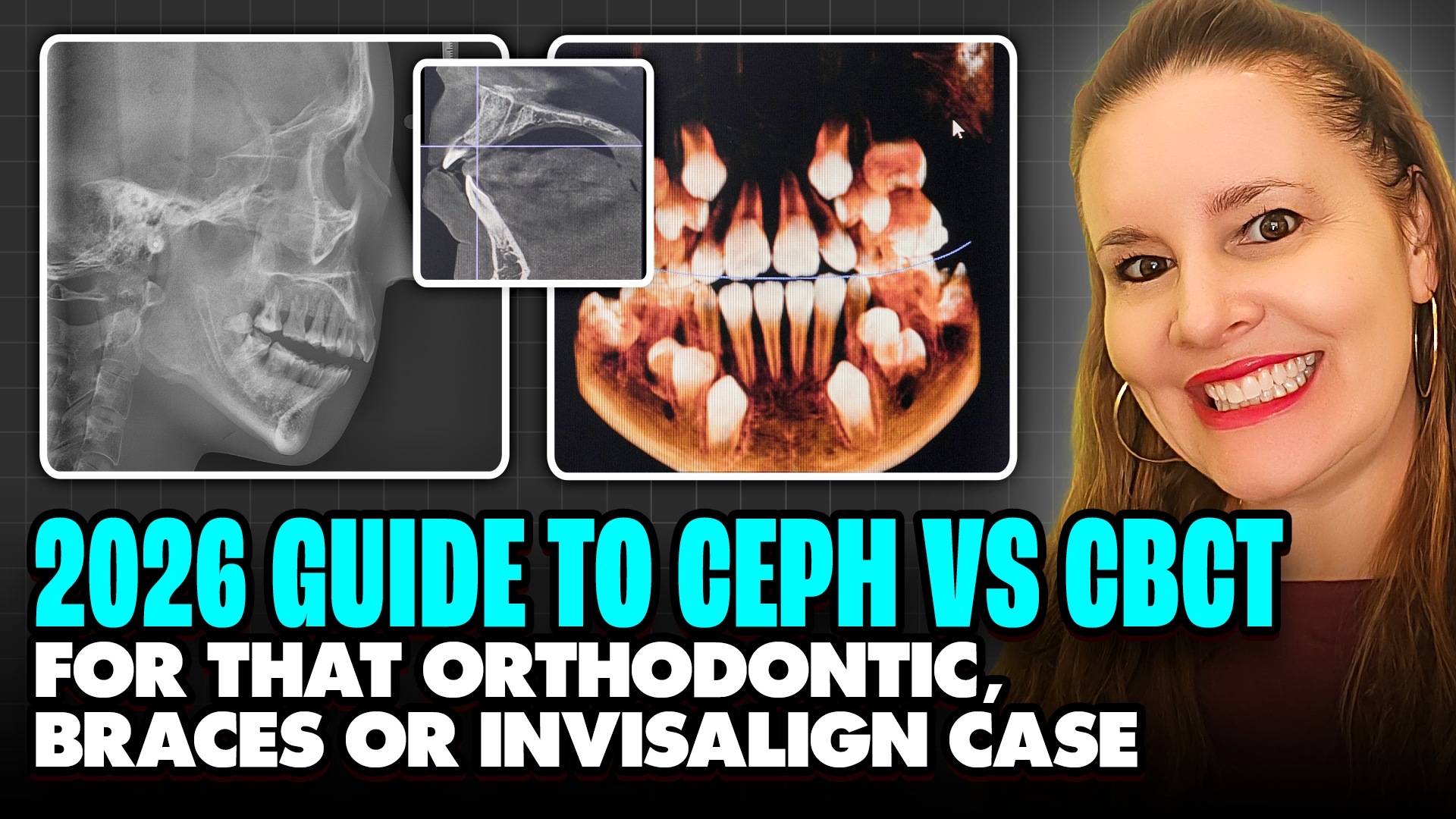
 2026 Guide to Buying a CBCT or 2D Digital Pan Ceph for Primary Care Ortho, Braces, and Invisalign
I. Introduction
Dr. Amanda from StraightSmile Solutions addresses a common question from new grads or those setting up an office: what radiology equipment should you buy if you plan to do ortho?
The decision depends on your location, practice type, and budget – there is no one-size-fits-all answer.
II. Do You Even Need Your Own Machine?
In high-overhead areas, it may make sense to refer patients to a nearby imaging center (within a mile or two) for pano, ceph, or CBCT.
Billing is easy and patients generally don’t mind.
However, in remote areas, you likely need to purchase your own.
III. Minimum Requirement: A Pano (Not Just FMX)
Using only an FMX for ortho diagnosis misses pathology, impacted teeth, supernumeraries, odontomas, etc.
If you miss something because you didn’t take a pano, you are liable.
For children, especially, a pano is strongly recommended.
Even adults benefit – many have unknown incidental findings.
IV. When Do You Need a Cephalometric X-ray (Ceph)?
For growing children (Phase 1 interceptive), you absolutely need a ceph to assess skeletal relationships.
You can obtain a ceph from a large-FOV CBCT by reconstructing a 2D image (may be slightly janky, but it works).
If you only have a traditional 2D pan/ceph machine, you cannot get CBCT functionality when needed.
V. Option 1: Large-FOV CBCT with Low-Dose 2D Reconstruction (All-in-One)
Pros:
Captures airway analysis, impacted canine location, TMJ issues, and skeletal pathology.
Single footprint saves office real estate.
True 3D data for complex ortho/surgical cases.
Cons:
Expensive ($90,000-$150,000 estimate).
Reconstructed 2D ceph images can have pixelation or motion artifacts.
Requires software licensing and specialized training.
You are legally responsible for every millimeter captured within the FOV (including C-spine, skull base, sinuses).
Incidental findings outside dentistry create medical liability – you must pay an oral radiologist (e.g., BeamReaders) to read the entire scan.
VI. Option 2: Dedicated 2D Digital Pan/Ceph Machine
Pros:
Crisp, pristine 2D images; fast scanning.
Much lower upfront cost.
Lowest radiation dose.
Zero liability for incidental findings (none captured beyond dentition).
Ideal for high-volume pediatric or orthodontic practices focused on early interceptive treatment, expansion, and routine tracking.
Cons:
Blind spots – cannot measure bone volume, cortical boundaries, true airway.
Cannot upgrade to 3D later.
VII. Liability Trap with CBCT
In the US, you are legally responsible for interpreting every structure within the FOV.
If a lesion or pathology is found in the sinuses, skull base, or C-spine and you miss it, you face extreme medical liability.
Therefore, if you buy a large-FOV CBCT, you must budget for recurring costs to have an oral radiologist read the entire scan.
VIII. Final Recommendation (from AI and Dr. Amanda)
For the vast majority of primary care, pediatric, and general dental offices doing routine ortho, a dedicated 2D digital pan/ceph machine is sufficient.
Reserve a large-FOV CBCT only for specialized clinical scopes that demand routine skeletal pathology mapping (e.g., complex surgical extractions, severe skeletal disharmonies, airway-focused practice).
If you buy the “big kahuna,” factor in the cost of outsourced radiology reading – patients may not want to pay, and Dr. Amanda will not read it for you.
IX. The Bottom Line
Pano is essential (FMX is not enough for ortho).
Ceph is necessary for growing children; can be derived from CBCT.
2D digital pan/ceph is cheaper, lower liability, and adequate for most ortho practices.
CBCT offers more data but comes with higher cost, training, and liability – budget for radiologist reads.
Choose based on your clinical scope, budget, and tolerance for liability.